
"Fail Fast" is Popular Advice. It is also dangerously incomplete.
Failing fast was designed to reduce the amount of time spent on inaction, to learn faster, to advance towards success faster. It is good advice, but incomplete.
Carter Cathey
2/2/20261 min read
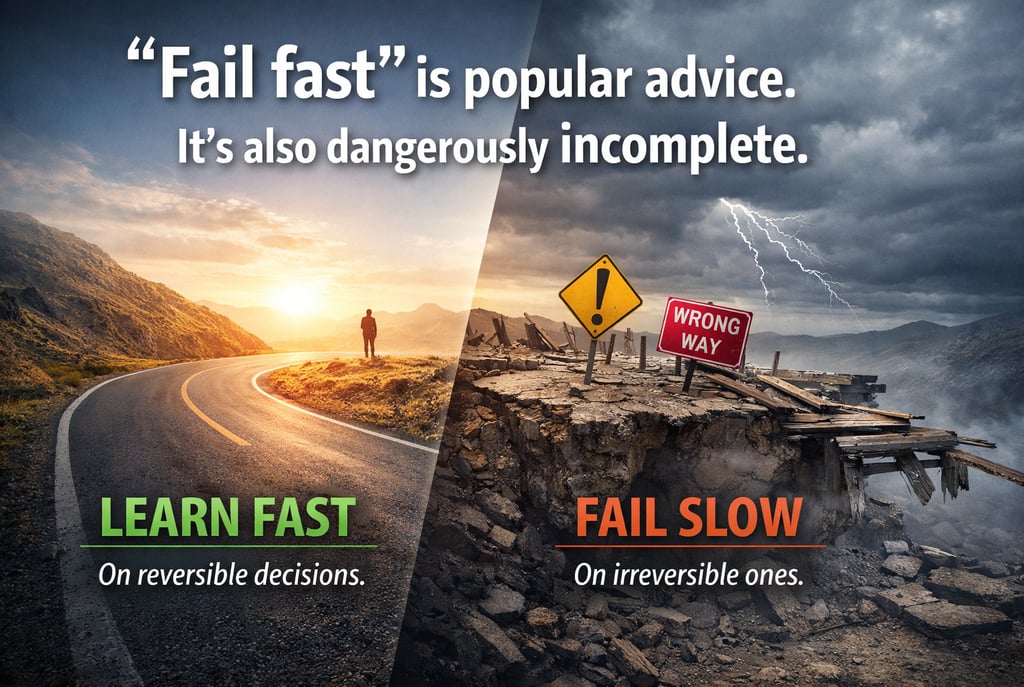
Failing fast can be useful. It helps teams avoid over-planning and sunk-cost denial.
But taken literally, it creates three real problems:
1️⃣ Not all failures are cheap
Failing fast on UI experiments is different from failing fast on pricing, trust, or enterprise credibility. Some mistakes don’t reset cleanly.
2️⃣ Speed without rigor creates noise, not learning
If you don’t define the hypothesis, success criteria, and learning goal, you didn’t fail fast, you just thrashed around making noise and organizational distraction.
3️⃣ It quietly lowers standards
“Fail fast” can become a euphemism for shipping half-baked work and calling it experimentation.
The better framing is this:
Fail fast on reversible decisions.
Be deliberate on irreversible ones.
Or even simpler:
Learn fast. Fail only as much as necessary.
High-performing teams don’t avoid failure, but they design it to produce signal, not chaos.
Curious how others think about this. Where should teams move fast, and where should they slow down?
Related Articles by Carter Cathey
About Carter Cathey
Carter Cathey is a sales and revenue leader with more than 20 years of experience helping market research, technology, and private-equity-backed businesses scale revenue, improve operations, and build predictable growth systems.
Throughout his career, he has led sales transformation initiatives, pricing strategy projects, subscription business model transitions, operational redesign efforts, and commercial growth programs.
He writes about leadership, organizational design, business systems, data-driven decision making, and the challenges companies face as they scale.
Learn more about Carter Cathey