
Founder Trust and Institutional Trust are NOT the Same Thing
Founder trust and institutional trust are not the same thing. Early in a company’s life, the founder’s judgment can drive quality and speed, but as organizations scale that same involvement can quietly become a bottleneck. Sustainable companies eventually shift trust from the founder’s instincts to systems that allow the organization to operate and evolve without constant founder intervention.
Carter Cathey
3/18/20262 min read
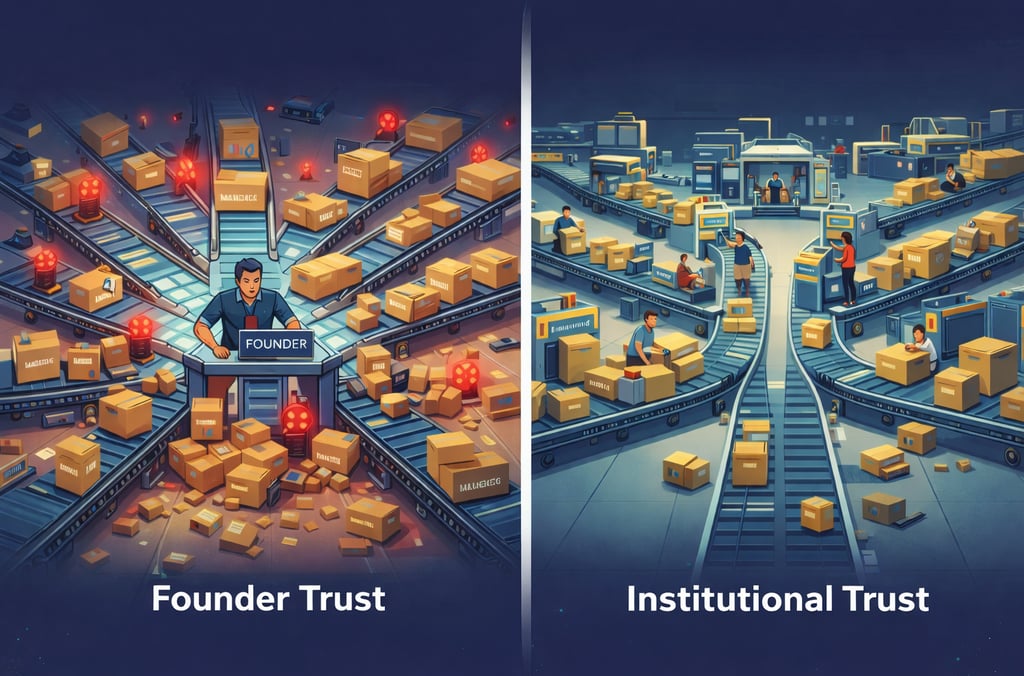
Founder trust = trust in a specific person.
People believe things will work because they believe in the founder.
This trust comes from:
charisma
reputation
personal relationships
past success
direct oversight
Examples:
Employees trust the strategy because the founder says it’s right.
Customers buy because they trust the founder’s brand.
Investors fund because they believe in the founder personally.
This works extremely well early in a company.
But it has limits:
It doesn’t scale well.
The founder becomes a single point of failure.
Decisions require personal authority rather than systems.
Institutional trust = trust in the system, not the person.
People believe things will work because the organization has reliable structures.
This trust comes from:
processes
governance
transparent decision rules
repeatable systems
accountability structures
Examples:
Employees trust the promotion process even if they don’t know the CEO.
Customers trust the brand even when leadership changes.
Investors trust the company because the systems produce results.
This is what allows companies to scale and survive leadership turnover.
Early in a company’s life, founder trust is incredibly powerful.
People trust the founder’s instincts, taste, and judgment. Decisions move quickly because everyone believes the founder will steer things in the right direction.
That works well… until the company starts to scale.
Years ago, I worked at a market research company where the founder had an exceptional creative eye. He cared deeply about the brand and liked to be involved in things like conference swag and the design and layout of the company website.
The website itself was custom-built by our developers. It wasn’t running on a drag-and-drop platform. Every change required engineering time.
Early on, this wasn’t a problem.
But as the company grew, the process started to look like this:
Marketing would develop ideas → schedule time with the founder for review → then schedule time with developers to implement the changes.
Things that could have been updated in minutes on a modern platform required multiple people, multiple calendars, and scarce technical resources.
When engineering priorities tightened, the website simply stopped evolving. It was effectively frozen because it kept falling to the bottom of the development queue.
Eventually the founder recognized the issue himself.
He realized that he had unintentionally become the bottleneck.
The marketing team rebuilt the website on a modern platform that required no development resources. From that point forward, they could iterate quickly and evolve the brand in real time.
The outcome was positive.
But the path there was longer and more painful than it needed to be.
The problem wasn’t the founder’s taste. His instincts were often right.
The problem was that the system required the founder’s involvement to function.
Founder trust works because people believe in the person.
Institutional trust works because people believe in the system.
At some point every growing organization has to make the transition between the two.
The companies that scale successfully are the ones that recognize when the founder has quietly become the bottleneck.
Related Articles by Carter Cathey
About Carter Cathey
Carter Cathey is a sales and revenue leader with more than 20 years of experience helping market research, technology, and private-equity-backed businesses scale revenue, improve operations, and build predictable growth systems.
Throughout his career, he has led sales transformation initiatives, pricing strategy projects, subscription business model transitions, operational redesign efforts, and commercial growth programs.
He writes about leadership, organizational design, business systems, data-driven decision making, and the challenges companies face as they scale.
Learn more about Carter Cathey