
Good Failure vs. Bad Failure
Not all failures are equal. Good failures test core assumptions quickly and cheaply, producing clear answers. Bad failures scale effort before validation—consuming time and resources while avoiding the real risk.
Carter Cathey
3/27/20261 min read
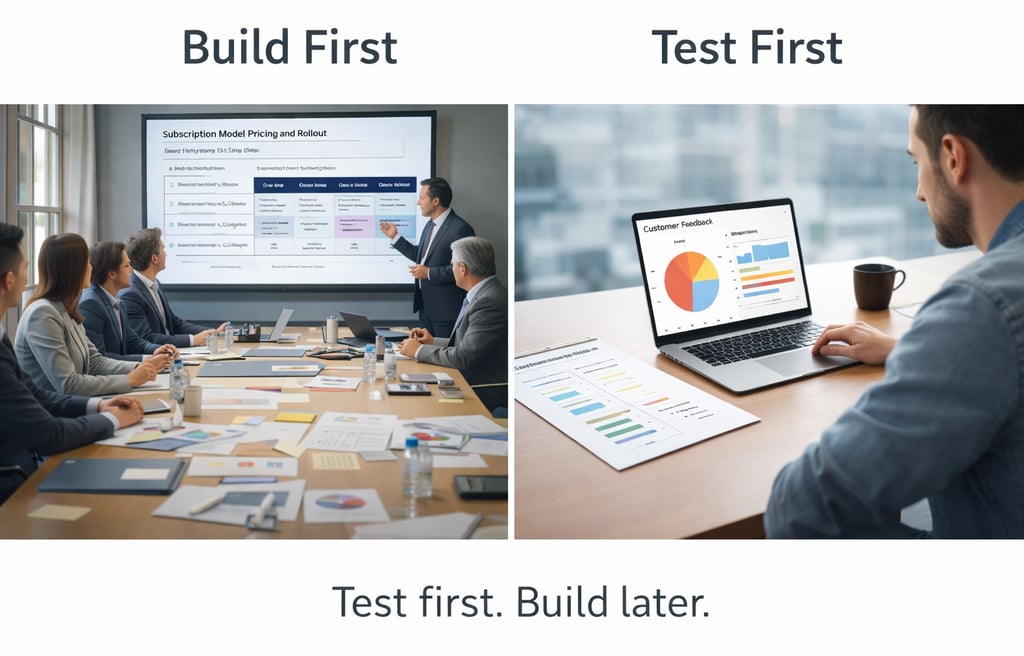
Not all failures are equal.
Some failures build capability.
Others just burn time, money, and credibility.
I saw this play out at a company I worked with years ago.
The business was largely project-based, and there was a push to shift toward a more predictable, subscription-style model.
On paper, it made sense:
more recurring revenue
more predictability
better valuation profile
The problem was the customer behavior didn’t match the model.
Clients:
valued flexibility
couldn’t predict future demand
didn’t want long-term commitments
Those issues were visible early.
But instead of pressure-testing them quickly, the organization spent months:
building pricing models
designing packaging
developing GTM strategies
preparing rollout plans
Eventually, the model launched.
And within weeks, it was clear:
the core issues hadn’t been solved.
The initiative was scrapped.
That’s not a failure problem.
That’s a process problem.
A good failure:
tests the hardest assumption early
minimizes time and resource exposure
produces a clear answer quickly
A bad failure:
avoids the core risk
scales investment before validation
hopes the market will adapt
Most companies say they want innovation.
But what they actually need is:
discipline in how they fail.
Related Articles by Carter Cathey
About Carter Cathey
Carter Cathey is a sales and revenue leader with more than 20 years of experience helping market research, technology, and private-equity-backed businesses scale revenue, improve operations, and build predictable growth systems.
Throughout his career, he has led sales transformation initiatives, pricing strategy projects, subscription business model transitions, operational redesign efforts, and commercial growth programs.
He writes about leadership, organizational design, business systems, data-driven decision making, and the challenges companies face as they scale.
Learn more about Carter Cathey