Heroes Don't Scale
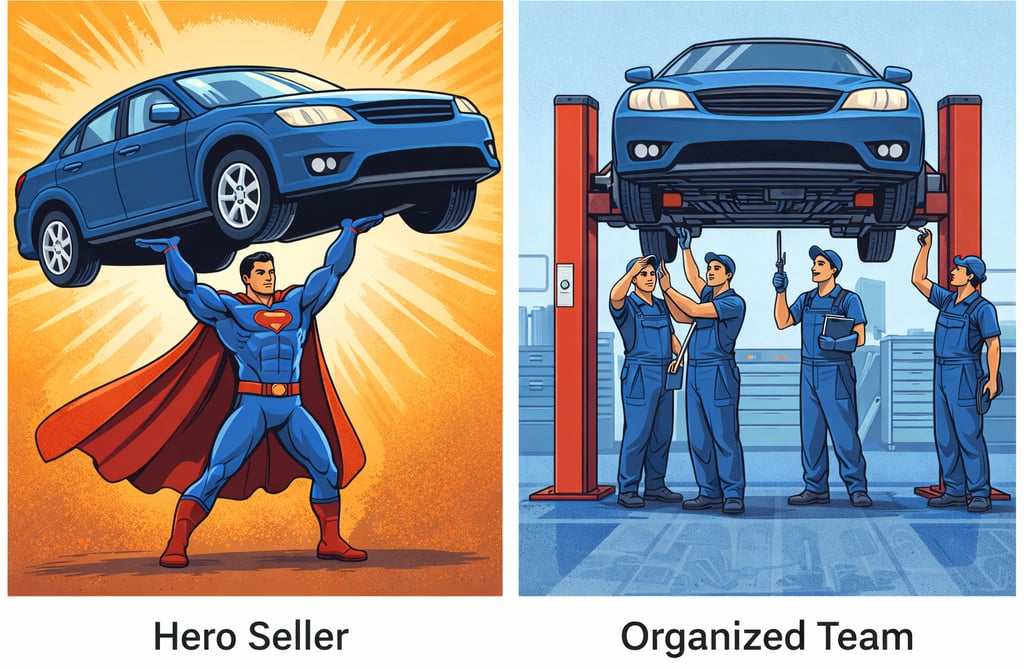
Revenue organizations that rely on “hero” sellers aren’t scaling — they’re concentrating risk. When top reps compensate for broken processes, unclear ICPs, and weak enablement, performance may look strong, but it’s fragile and dependent on individual brilliance. Sustainable growth comes from building systems where average reps can win and success survives turnover.
Carter Cathey
2/20/20262 min read
Last week, I wrote about the danger of building around “unfireable” reps — the kind of seller who becomes indispensable because they consistently deliver, even when the system around them doesn’t.
That story wasn’t really about one person.
It was about organizational design.
Here’s the structural version of that lesson:
Heroes don’t scale. Systems do.
And if your growth plan depends on one or two exceptional sellers, you don’t have a revenue engine.
You have concentration risk.
1️⃣ Heroes Mask Structural Weakness
When a company has a true hero rep, a few things tend to happen:
ICP definition stays fuzzy.
Messaging remains inconsistent.
Qualification discipline erodes.
Enablement gaps persist.
Process friction gets tolerated.
Why?
Because the hero “figures it out.”
They compensate for unclear positioning.
They rewrite the pitch in their head.
They navigate broken handoffs.
They rescue late-stage deals.
As long as they hit the number, the pressure to fix the system decreases.
Performance looks fine.
But it’s being propped up.
2️⃣ Heroes Inflate Perceived Product-Market Fit
If only the top 10% of your team can reliably win, that’s not strong product-market fit.
That’s talent arbitrage.
You’re borrowing brilliance instead of building repeatability.
True PMF shows up differently:
Average reps can close.
Ramp time compresses.
Win rates stabilize.
Pipeline conversion becomes explainable.
When wins feel mysterious — “She just has a knack for it” — that’s a signal.
Not of genius.
Of fragility.
3️⃣ Heroes Distort Forecast Confidence
This is where leadership risk compounds.
Revenue looks healthy.
Quotas are being hit.
The board sees momentum.
But underneath:
Two people carry 40–60% of production.
Their pipelines are disproportionately weighted.
Their departures would materially alter outcomes.
That’s not scale.
That’s volatility disguised as strength.
Spikes impress.
Curves endure.
The Real Leadership Question
The wrong question is:
“How do we retain our top reps?”
The better question is:
“If they left tomorrow, what would still work on Monday?”
Would pipeline quality hold?
Would messaging survive?
Would forecast accuracy remain stable?
Would average performers still win?
If the answer is no, the work isn’t retention.
It’s system design.
Great Teams Don’t Depend on Exceptions
In a scalable revenue organization:
Performance variance tightens.
Wins are explainable.
Average talent performs well.
Ramp is predictable.
Forecasts are durable.
Top performers still exist.
But they accelerate a functioning system — they don’t compensate for a broken one.
Heroes win quarters.
Teams win years.
If your growth depends on exceptional people compensating for structural gaps, you haven’t built a scalable organization.
You’ve concentrated risk.
And concentrated risk eventually surfaces.
Related Articles by Carter Cathey
About Carter Cathey
Carter Cathey is a sales and revenue leader with more than 20 years of experience helping market research, technology, and private-equity-backed businesses scale revenue, improve operations, and build predictable growth systems.
Throughout his career, he has led sales transformation initiatives, pricing strategy projects, subscription business model transitions, operational redesign efforts, and commercial growth programs.
He writes about leadership, organizational design, business systems, data-driven decision making, and the challenges companies face as they scale.
Learn more about Carter Cathey