
Hiring Doesn’t Fail. It Reflects What You Actually Value
Hiring decisions often reflect comfort, familiarity, and access more than actual capability. Companies say they want high performers, but consistently select for people they like, people they know, or people who fit a preconceived mold. Over time, those choices shape the team far more than the stated hiring criteria.
Carter Cathey
4/15/20262 min read
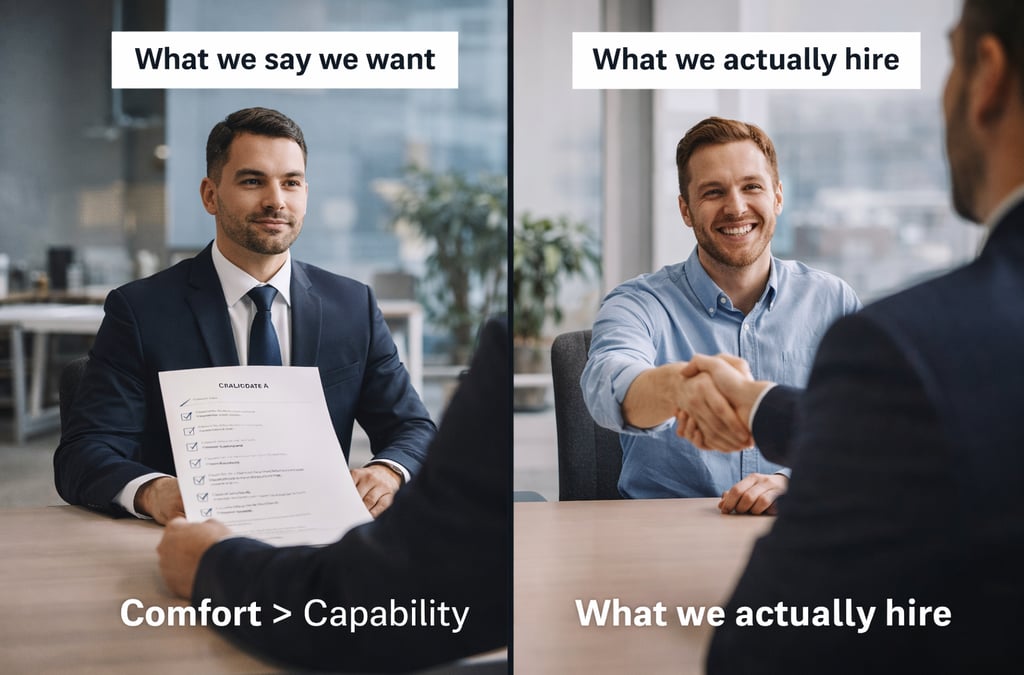
Companies say they want high performers.
They say they want people who can execute, who can think, who can actually move the business forward.
But if you look closely at how hiring decisions get made, you often see something very different.
People hire who they like.
Sometimes that shows up in obvious ways. I worked with a recruiter early in her career who openly talked about trying to hire young, attractive people to improve the company’s dating pool. That’s an extreme example, but it exposes a very real bias that shows up in more subtle ways across organizations. Leaders gravitate toward people who feel familiar, who share their outlook, who are easy to talk to, who they can imagine grabbing a beer with. That can matter in some roles, but in many cases it has very little to do with actual job performance.
Other times, the bias shows up as hiring for network.
The job description talks about capability, about process, about how the role creates value. But the interview quickly shifts to one question: who do you know? In sales, this is especially common. Can you call your Rolodex and bring in revenue quickly? That might produce short-term wins, but it often replaces durable capability with temporary access.
And then there’s hiring a “type.”
This shows up most clearly when people who don’t deeply understand the role are making hiring decisions. In sales, it’s the assumption that the loudest, most gregarious person must be the best seller. It’s a stereotype that ignores how complex the job actually is, and how many different profiles can be highly effective depending on the motion, the customer, and the product.
Over time, these patterns compound.
You say you want performance.
But you reward familiarity.
You reward access.
You reward comfort.
And you end up with a team that reflects those choices.
If you want a different outcome, don’t just rewrite the job description.
Change what actually gets selected for.
Related Articles by Carter Cathey
About Carter Cathey
Carter Cathey is a sales and revenue leader with more than 20 years of experience helping market research, technology, and private-equity-backed businesses scale revenue, improve operations, and build predictable growth systems.
Throughout his career, he has led sales transformation initiatives, pricing strategy projects, subscription business model transitions, operational redesign efforts, and commercial growth programs.
He writes about leadership, organizational design, business systems, data-driven decision making, and the challenges companies face as they scale.
Learn more about Carter Cathey