
When Top Performers Become a Single Point of Failure
Sales organizations often rely on a small number of high-performing “hero” sellers to drive results, creating hidden risk and limiting scalability. While supporting top performers is important, over-reliance on them can lead to burnout, inconsistent standards, and a lack of team-wide capability. Sustainable growth comes from building systems that distribute success rather than concentrating it.
Carter Cathey
5/4/20261 min read
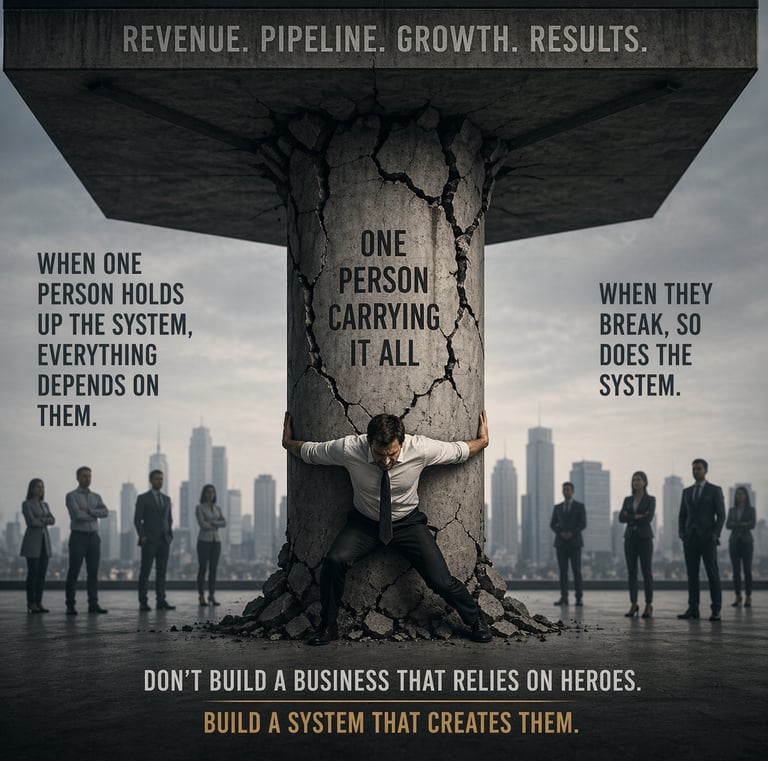
There is a difference between supporting your top performers and building a system that depends on them.
Most sales leaders understand the first part. Fewer recognize when they’ve crossed into the second.
I’ve seen teams where a small number of “hero” sellers drive a disproportionate share of the results. They are highly capable, trusted with the most important opportunities, and often given flexibility in how they operate. In the short term, this can work very well.
Over time, it creates a different problem.
More deals get routed to the same individuals. They become the default solution for anything complex or high value. Processes become optional because “that’s not how they work.” The rest of the team gradually shifts into supporting roles rather than developing the ability to operate independently.
What looks like strong performance is often a concentration of risk.
A hero-based culture creates a single point of failure in what should be a distributed system. It limits how far the organization can scale, and it increases the impact when something inevitably changes. People burn out. They hit capacity. Or they leave.
When that happens, the gap between individual performance and team capability becomes very clear.
This is not an argument against supporting top performers. It’s an argument for building systems that make success repeatable.
You don’t scale a sales organization by finding more heroes.
You scale it by building a system that doesn’t require them.
Related Articles by Carter Cathey
About Carter Cathey
Carter Cathey is a sales and revenue leader with more than 20 years of experience helping market research, technology, and private-equity-backed businesses scale revenue, improve operations, and build predictable growth systems.
Throughout his career, he has led sales transformation initiatives, pricing strategy projects, subscription business model transitions, operational redesign efforts, and commercial growth programs.
He writes about leadership, organizational design, business systems, data-driven decision making, and the challenges companies face as they scale.
Learn more about Carter Cathey