
Convert Sales Targets into Activities: 5 easy steps!
Abstract goals seem overwhelming because they don't inform activities. It is only when you break them down and understand the activities needed that you can understand what you need to do to be successful.
Carter Cathey
12/18/20251 min read
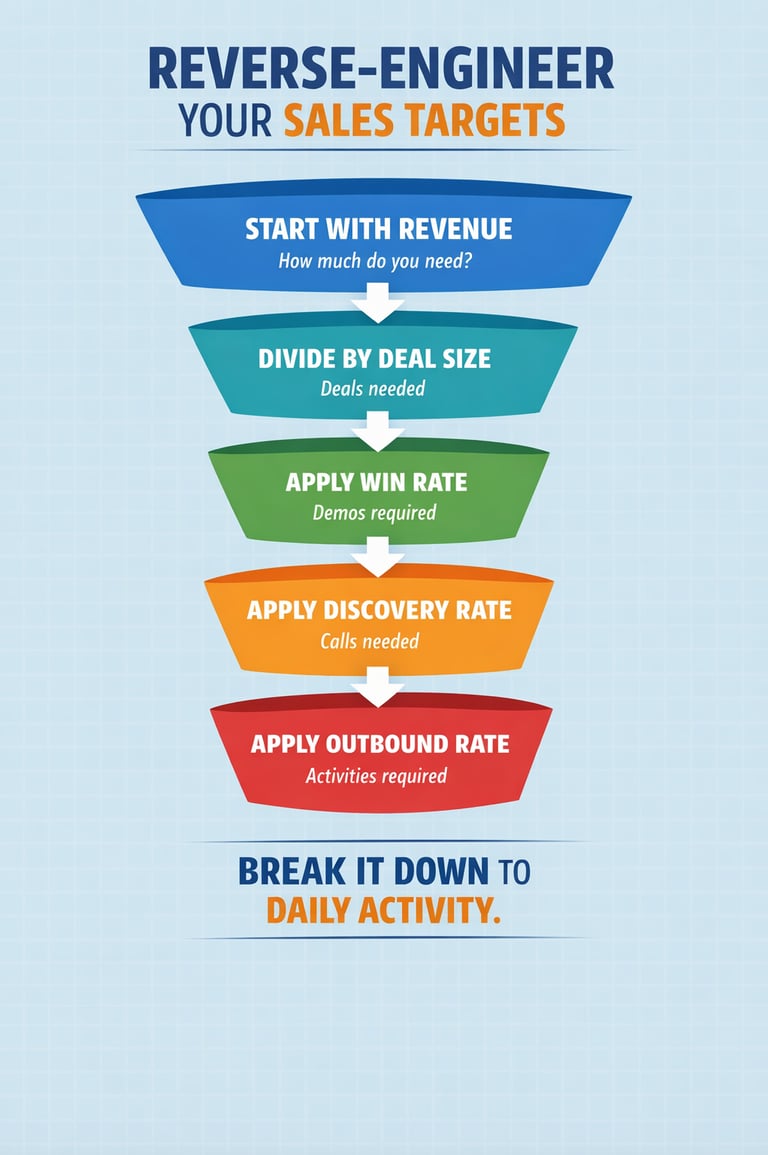
Reverse-engineering your sales target changes everything.
Most sales goals fail because they’re treated like wishes, not math.
If your annual quota is $X, you don’t “work harder” — you work backwards.
Here’s the framework I use 👇
1️⃣ Revenue target
Start with the number that matters:
→ $X in closed-won revenue
2️⃣ Average deal size
$X ÷ average deal size =
→ Number of deals you must close
3️⃣ Close rate
Deals ÷ win rate =
→ Number of demos/proposals required
4️⃣ Demo → discovery conversion
Demos ÷ conversion rate =
→ Number of discovery calls needed
5️⃣ Discovery → outbound conversion
Discovery calls ÷ conversion rate =
→ Number of outbound activities required
Now your quota isn’t abstract anymore.
It’s calls, emails, touches, and conversations.
What’s often missing from this model:
Deal velocity (how long opportunities take to close)
Capacity constraints (how many quality activities you can actually do)
Pipeline coverage (most teams need 3–5x quota in pipeline)
Channel mix (outbound vs inbound vs referrals don’t convert the same)
Once you see the full math, you stop guessing — and start managing activity with intent.
Sales targets aren’t pressure.
They’re just poorly explained equations.
If you can’t hit the required call volume, the answer isn’t to make more calls.
The math already told you that.
When the activity number is unrealistic, the lever isn’t effort — it’s efficiency.
Instead of forcing more dials, look at:
Bigger deal sizes (selling higher-value problems)
Higher win rates (better qualification, tighter ICP)
Stronger conversation rates (messaging that earns replies)
Every improvement upstream reduces the volume required downstream.
More calls is the laziest answer.
Better economics is the right one.
Related Articles by Carter Cathey
About Carter Cathey
Carter Cathey is a sales and revenue leader with more than 20 years of experience helping market research, technology, and private-equity-backed businesses scale revenue, improve operations, and build predictable growth systems.
Throughout his career, he has led sales transformation initiatives, pricing strategy projects, subscription business model transitions, operational redesign efforts, and commercial growth programs.
He writes about leadership, organizational design, business systems, data-driven decision making, and the challenges companies face as they scale.
Learn more about Carter Cathey