
Growth & Scaling: Why Hiring Ahead of Process Creates Chaos
Growth exposes weaknesses that small teams can hide. When companies hire aggressively before establishing process, onboarding, management structure, and operational support, they often create confusion instead of growth. The result is a larger team producing less than the smaller team it replaced.
Carter Cathey
7/15/20263 min read
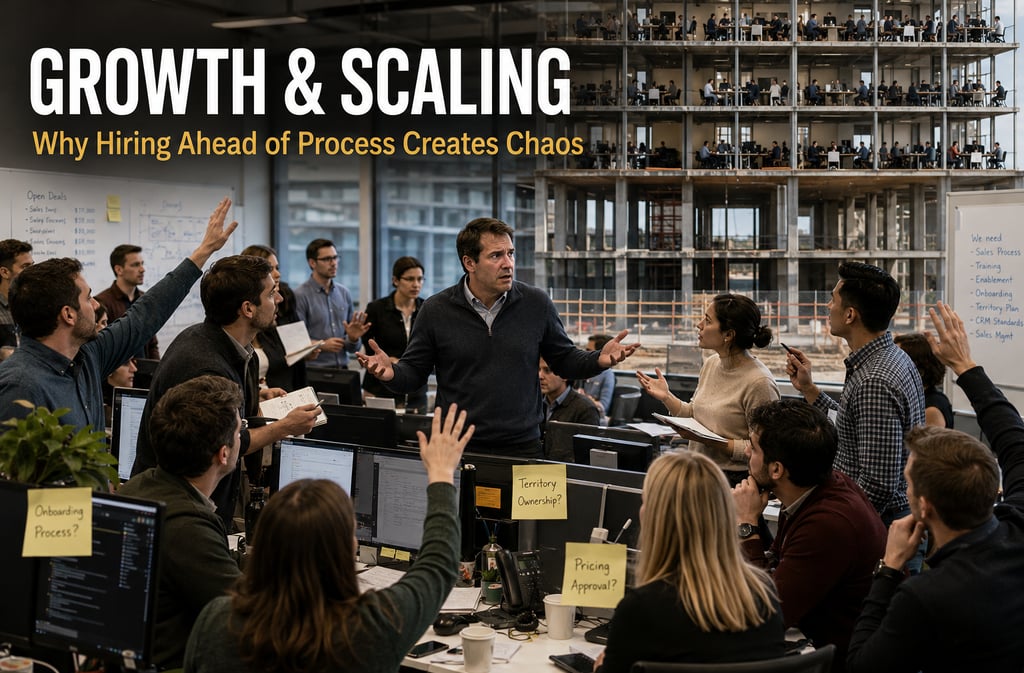

Many startups survive their early years through heroics.
The founders know every customer. The first salespeople helped build the product. Everyone sits close enough to ask questions, solve problems, and fill gaps as they appear. Processes exist, but they exist mostly in people's heads.
For a while, this works. Then funding arrives. Investors want growth. Revenue targets increase. Hiring plans accelerate. Leadership decides it is time to build a larger sales organization.
So they hire. Five salespeople become ten. Ten become twenty. And almost immediately, performance begins to deteriorate. The assumption was that more salespeople would create more revenue. Instead, the organization becomes slower, noisier, and less productive.
The problem is rarely the people. The problem is that the company hired ahead of its infrastructure.
The Small Team Illusion
A two-person sales team can operate with surprisingly little structure. Territories can be informal. Pricing decisions can happen in a quick conversation. Customer questions can be answered by walking over to a founder's desk.
Knowledge is tribal because everyone already knows everything. The organization mistakes this for efficiency. In reality, it is dependency.
The system functions because a handful of people possess years of accumulated context. The moment new people arrive, that context disappears.
New Hires Don't Inherit Institutional Knowledge
Founders often forget that their original employees watched the company evolve. They participated in every product decision. They know why pricing changed. They understand which customers are ideal and which are not. They know which shortcuts are safe and which are dangerous.
New hires arrive without any of this history. They need answers.
How do we position the product?
Who owns this account?
What qualifies as a good opportunity?
What discount authority do I have?
How does implementation work?
What does success look like?
Without documented processes, every answer requires interruption. The people who were previously selling now spend their time explaining. The people who were previously building now spend their time answering questions.
Productivity falls across the organization.
The CEO Becomes the Bottleneck
One of the most common patterns I have seen is the founder-led sales team. With two or three experienced sellers, this arrangement works reasonably well. Those salespeople are independent. They need little oversight. The CEO spends most of their time focused on customers, investors, product, and strategy.
Then the company hires ten additional people. Suddenly everyone needs something.
Approvals.
Coaching.
Deal reviews.
Pricing exceptions.
Territory decisions.
Escalations.
Priority setting.
The CEO discovers that managing three experienced sellers and managing twelve developing sellers are entirely different jobs. What once required a few hours per week now becomes a full-time responsibility.
Unfortunately, the CEO still has all of their previous responsibilities. The result is organizational gridlock. Every important decision waits for one person.
Growth Multiplies Operational Debt
Most organizations think they are hiring salespeople. What they are actually hiring is demand for infrastructure.
More salespeople require:
Structured onboarding
Sales management
Territory definitions
Compensation administration
CRM governance
Training programs
Forecasting processes
Marketing support
Sales operations
Customer success capacity
Implementation resources
Each new hire creates pressure on systems that may not yet exist. Without those systems, productivity decreases as headcount increases. This often surprises leadership because activity rises dramatically.
There are more meetings.
More pipeline.
More conversations.
More internal communication.
The company feels busier than ever. Yet revenue growth stalls because the organization is spending its energy managing complexity instead of serving customers.
Build the Foundation Before Adding Floors
The best scaling organizations recognize that growth requires two parallel investments. The first investment is talent. The second investment is infrastructure.
Before adding significant headcount, leaders should ask:
Is our sales process documented?
Can a new employee become productive without constant founder involvement?
Are territories clearly defined?
Do managers have reasonable spans of control?
Is onboarding repeatable?
Are pricing and approval processes understood?
Can our operational teams absorb additional demand?
If the answer to these questions is no, additional hiring may create more problems than it solves.
Growth Is a System Problem
The irony is that aggressive hiring is usually a sign of success.
The company has raised money.
The market opportunity appears real.
Investors are optimistic.
Yet success often reveals weaknesses that were previously hidden. Small teams can compensate for missing processes through relationships, experience, and institutional knowledge. Large teams cannot.
Growth does not eliminate organizational weaknesses. It exposes them. The companies that scale successfully understand that hiring people is only part of the equation. The real challenge is building the systems, processes, and leadership structure that allow those people to succeed.
Otherwise, growth becomes the very thing that slows the company down.
Recommended Internal Links
About Carter Cathey
Carter Cathey is a sales and revenue leader with more than 20 years of experience helping market research, technology, and private-equity-backed businesses scale revenue, improve operations, and build predictable growth systems.
Throughout his career, he has led sales transformation initiatives, pricing strategy projects, subscription business model transitions, operational redesign efforts, and commercial growth programs.
He writes about leadership, organizational design, business systems, data-driven decision making, and the challenges companies face as they scale.
Learn more about Carter Cathey