
Growth & Scaling: The Hidden Complexity of Success
Many successful companies appear simpler than they really are. This article explores how growth often exposes hidden complexity, undocumented processes, manual workarounds, and critical knowledge trapped inside a handful of employees. The organizations that scale most effectively are the ones that identify and address these hidden dependencies before growth turns them into bottlenecks.
Carter Cathey
7/13/20263 min read
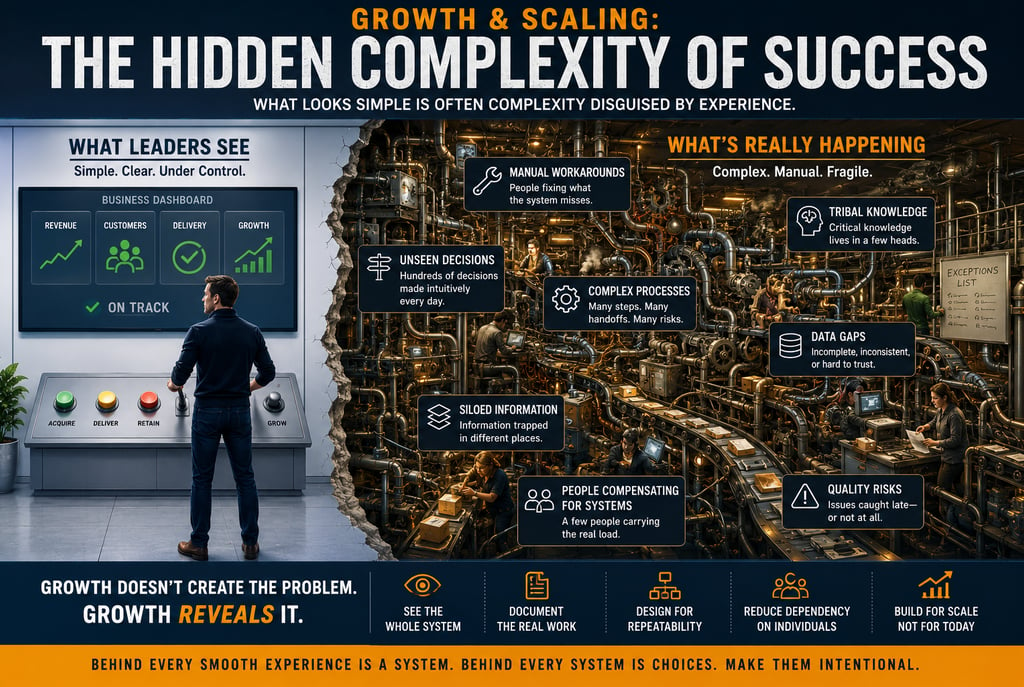

One of the most surprising things about growth is that success often makes a business look simpler than it really is. Founders frequently look at their organizations and see a straightforward story.
They worked hard
They built a great product
They found customers
They created value
The business grew
The challenge is that many successful businesses aren't nearly as simple as they appear. What often looks like a clean, scalable operation is actually a highly complex system being operated intuitively by a small number of people.
And that complexity frequently remains invisible until growth exposes it.
Complexity Hides Inside Success
One of the reasons this happens is that successful people stop seeing complexity.
They've spent years accumulating knowledge
They know the customers
They know the product
They know the pricing
They know the exceptions
They know which problems matter and which can be ignored
Thousands of decisions that once required conscious thought become instinctive. From the founder's perspective, the business feels simple. From the perspective of a new employee, it often feels overwhelming.
What looks simple from the inside is often highly complex from the outside.
The Delegation Test
One of the easiest ways to identify hidden complexity is through delegation.
A founder hires someone
Explains the role
Answers a few questions
Then becomes frustrated when the new employee struggles
The founder says: "It's not that complicated."
But often it is. The founder has simply forgotten how much knowledge they have accumulated over the years.
The complexity was always there. It was simply hidden inside experience.
Success Can Hide Defects
Sometimes success doesn't just hide complexity. It hides problems.
Years ago, I worked for a company that viewed itself as a SaaS company. The reality was that it was closer to a professional services company supported by technology. The platform handled much of the work. But not all of it.
There was a team of three relatively junior employees responsible for a variety of operational tasks. As sales grew, we began experiencing delivery issues. Projects started falling through the cracks.
Initially, leadership assumed something had recently broken. What we eventually discovered was that nothing had changed. The technology had never fully worked as intended. Those three employees had been manually correcting exceptions, reviewing outputs, and performing critical quality-control activities for years.
At fifty active projects, they could manage the workload
At seventy-five projects, they were stretched
At one hundred projects, the system started failing
Growth didn't create the problem. Growth increased the visibility of the problem.
The Most Dangerous Complexity
The most dangerous complexity is the complexity you don't know exists. Many organizations believe their success is being created by systems.
In reality, success may be coming from:
spreadsheets
manual workarounds
tribal knowledge
undocumented processes
key individuals quietly compensating for weaknesses
One of the reasons manual work becomes so dangerous is that it often becomes invisible.
The organization sees the output. It doesn't see the effort required to create it. As long as the output remains consistent, leaders assume the process is working.
What they don't realize is that people may be compensating for the process every day.
Success Often Rewards the Wrong Conclusion
One of the most dangerous assumptions leaders make is: "We're successful, therefore our systems must be working." Success can hide all kinds of weaknesses.
I've written previously about Why Early Success Creates Bad Habits and How Success Can Hide Structural Weaknesses.
Many organizations discover weaknesses only after growth slows or complexity increases. The weaknesses were always present. Success simply prevented anyone from noticing them. In some cases, growth itself becomes the diagnostic tool.
The business reaches a scale where the hidden weaknesses can no longer remain hidden.
The Hero Problem
This challenge is closely connected to another scaling issue: dependence on key people.
I've explored this in The Difference Between a Startup and a Company and When the Founder Becomes the Bottleneck.
Many organizations don't realize how much complexity is being managed by a handful of individuals.
One person understands pricing
One person understands delivery
One person understands the reporting
One person knows all the exceptions
The business appears scalable because those people consistently make the complexity look manageable.
When volume increases—or one of those people leaves—the organization discovers how much knowledge was trapped inside individuals rather than systems.
Growth Exposes Reality
One of the most important lessons I've learned is that growth rarely creates problems. Growth exposes them.
Communication issues become visible
Process issues become visible
Data quality issues become visible
Role clarity issues become visible
Technology limitations become visible
The weaknesses were usually there all along. Growth simply increased the volume enough that the organization could no longer compensate for them.
Final Thought
One of the biggest surprises in scaling is discovering that success was never as simple as it appeared.
What looked like a straightforward business was often a highly complex system being operated by a small number of people with years of accumulated knowledge.
Growth doesn't create that complexity. Growth simply exposes it.
And the organizations that scale most successfully are the ones that learn to move knowledge out of people's heads and into systems before growth forces the issue.
Related Articles by Carter Cathey
About Carter Cathey
Carter Cathey is a sales and revenue leader with more than 20 years of experience helping market research, technology, and private-equity-backed businesses scale revenue, improve operations, and build predictable growth systems.
Throughout his career, he has led sales transformation initiatives, pricing strategy projects, subscription business model transitions, operational redesign efforts, and commercial growth programs.
He writes about leadership, organizational design, business systems, data-driven decision making, and the challenges companies face as they scale.
Learn more about Carter Cathey