
How Systems Work: When Leadership, Sales, and Customers Stop Seeing the Same Reality
As organizations grow, leadership teams, frontline employees, and customers often develop increasingly different perceptions of the business, product, and market. These “reality gaps” create strategic misalignment, slow adaptation, and prevent organizations from confronting emerging weaknesses honestly. Alignment improves when companies intentionally expose and reconcile these perception gaps rather than assuming everyone sees the business the same way.
Carter Cathey
6/5/20262 min read
One of the most interesting exercises I ever built inside a company came from a simple realization:
The executive team, the sales team, and our customers were often operating from completely different versions of reality.
At first, the disagreements felt isolated.
Sales thought pricing was too high.
Leadership believed the product could command a significant premium.
Customers valued the product differently than either group expected.
But eventually I realized this pattern repeated itself almost regardless of the question being asked.
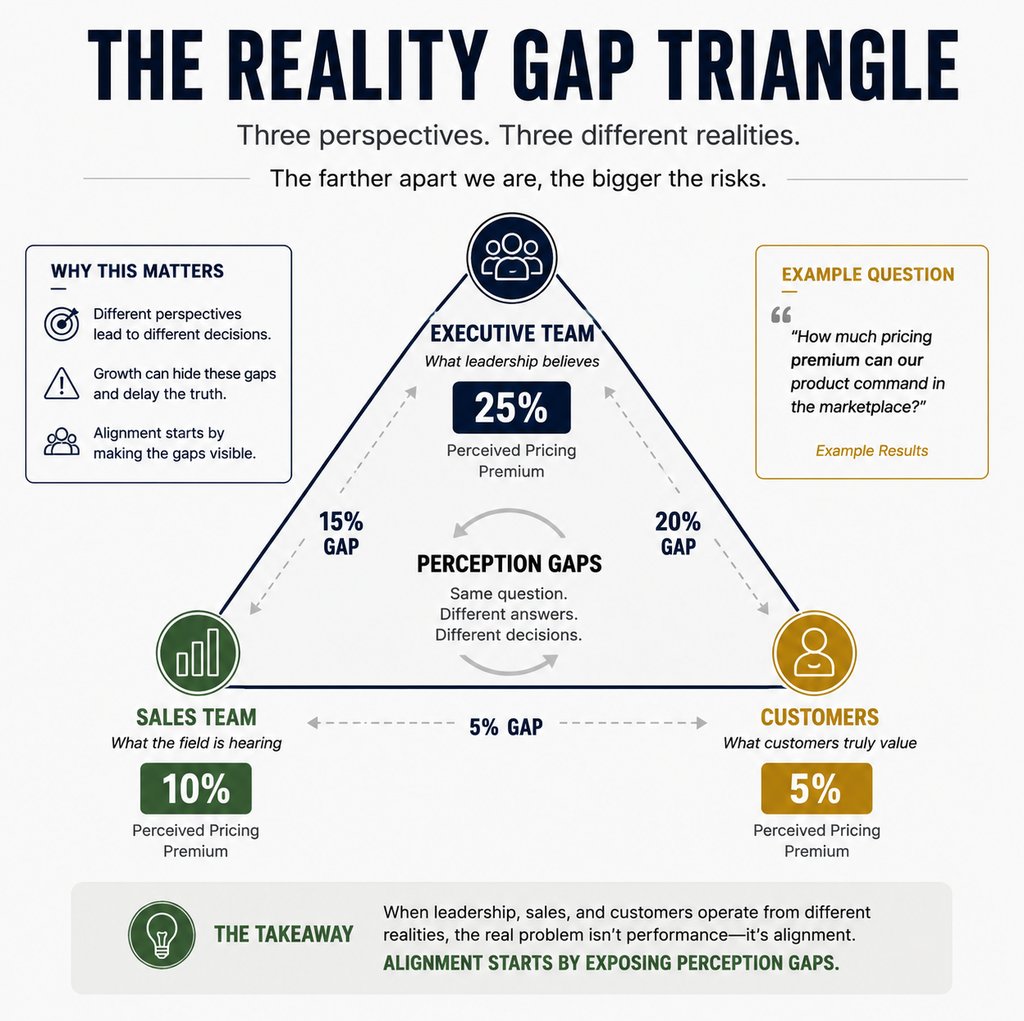
So I started mapping it visually.
At one point of the triangle: what the executive team believed
At another: what the sales team believed
At the third: what customers actually believed
And the gaps were often striking.
For example:
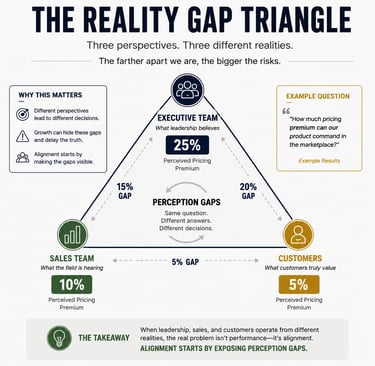
“How much pricing premium can our product command in the marketplace?”
Executive Team: 25%
Sales Team: 10%
Customers: 5%
What made the exercise powerful wasn’t proving that one group was “right.”
It was exposing how disconnected the perspectives had become.
Without something objective to anchor the discussion, these conversations often became organizational stalemates.
Leadership believed sales lacked confidence.
Sales believed leadership was disconnected from the market.
Neither side could move the conversation forward.
The customer perspective changed that.
It introduced an external reference point.
And what I found repeatedly was that executive teams were often describing the company as it had existed several years earlier, while customers were reacting to the company as it existed today.
That’s an important distinction.
As companies grow, leadership naturally becomes farther removed from:
daily customer friction
pricing resistance
competitive positioning
changing market perception
Meanwhile, frontline teams absorb these signals constantly.
But sales teams have their own distortions too:
recent deal losses
emotional reactions
anecdotal patterns
The point wasn’t that sales was always correct.
The point was that the organization had stopped operating from a shared reality.
And that’s when alignment starts to break down.
I think this happens far more often than organizations realize.
Growth can hide these gaps for a long time.
When business is expanding rapidly, companies often assume:
systems are stronger than they are
products are more differentiated than they are
teams are more aligned than they are
But eventually, growth slows.
And suddenly, the hidden gaps between leadership perception, operational reality, and customer experience become impossible to ignore.
The goal of the exercise was never to prove who was right.
It was to make the perception gaps visible enough that the organization could start learning from them.
Because companies rarely fail because nobody sees the problem.
They fail because different parts of the organization are operating from fundamentally different versions of reality.
Related Articles by Carter Cathey
About Carter Cathey
Carter Cathey is a sales and revenue leader with more than 20 years of experience helping market research, technology, and private-equity-backed businesses scale revenue, improve operations, and build predictable growth systems.
Throughout his career, he has led sales transformation initiatives, pricing strategy projects, subscription business model transitions, operational redesign efforts, and commercial growth programs.
He writes about leadership, organizational design, business systems, data-driven decision making, and the challenges companies face as they scale.
Learn more about Carter Cathey