
How Systems Work: How Success Can Hide Structural Weaknesses
Rapid growth can create the illusion that an organization’s systems, teams, and products are stronger than they actually are. In favorable environments, structural weaknesses often remain hidden because demand, momentum, and market conditions compensate for operational inefficiencies. The real test of organizational strength begins when growth slows and companies must confront weaknesses that were present all along.
Carter Cathey
6/8/20262 min read

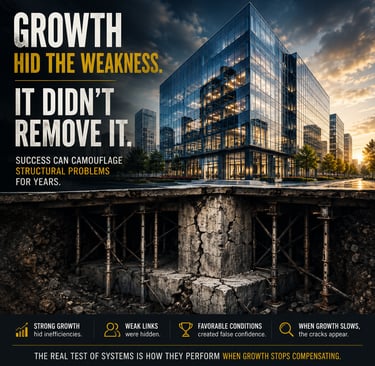
One of the most dangerous things about rapid growth is that it can make organizations believe they are operating far better than they actually are.
When business is expanding quickly, companies often assume:
their systems are strong
their teams are highly effective
their product is highly differentiated
their processes are scalable
And sometimes those things are true.
But sometimes growth is simply hiding structural weakness.
I’ve seen this happen repeatedly.
In favorable environments, organizations often mistake momentum for operational excellence.
Weak systems still produce acceptable outcomes because demand is strong.
Weak performers remain hidden because stronger team members compensate for them.
Products appear more differentiated because the market environment is favorable, competitors are weak, or customers are more forgiving.
The cracks exist.
They’re just difficult to see while growth is compensating for them.
Then growth slows.
And suddenly, what looked like isolated issues begin appearing everywhere at once:
execution inconsistency
customer dissatisfaction
operational inefficiency
declining win rates
communication breakdowns
onboarding problems
leadership friction
At that moment, many organizations instinctively believe: “Something broke.”
But often, nothing new actually broke.
The weaknesses were already there.
Growth had simply been hiding them.
And this is one of the hardest truths for leadership teams to confront emotionally.
Because accepting that reality means acknowledging that the organization may never have been operating as effectively as everyone believed.
It also means accepting that success itself may have reduced scrutiny.
Growth creates optimism.
Optimism creates confidence.
Confidence often reduces organizational curiosity.
The assumption becomes: “If we’re succeeding, the systems must be working.”
But favorable conditions can camouflage weak systems for a very long time.
One of the other patterns I’ve seen is that organizations often search for a single explanation when these problems emerge.
They look for:
one broken process
one weak leader
one market shift
one product issue
But systemic problems rarely reveal themselves one issue at a time.
Organizations are interconnected systems.
Sales, marketing, operations, product, onboarding, leadership, incentives, and communication all interact continuously.
Trying to fix systemic weakness by changing one isolated variable is often like editing one line of code in a 4,000-line program and expecting transformational results.
The real challenge is that once growth stops masking structural weakness, organizations often need much broader operational reflection than they initially want to admit.
The most dangerous structural weaknesses are often the ones hidden by success.
Because the real test of systems isn’t how they perform during rapid growth.
It’s how they perform once growth stops compensating for their weaknesses.
Related Articles by Carter Cathey
About Carter Cathey
Carter Cathey is a sales and revenue leader with more than 20 years of experience helping market research, technology, and private-equity-backed businesses scale revenue, improve operations, and build predictable growth systems.
Throughout his career, he has led sales transformation initiatives, pricing strategy projects, subscription business model transitions, operational redesign efforts, and commercial growth programs.
He writes about leadership, organizational design, business systems, data-driven decision making, and the challenges companies face as they scale.
Learn more about Carter Cathey