
Why Adding More Sellers Stops Working
Sales organizations stop scaling when success depends on specific individuals rather than repeatable systems. Founder-led sales, reliance on “supersellers,” lack of process, and weak market alignment can all create hidden dependencies that limit growth. Scaling is not about adding headcount—it’s about making success transferable across the team.
Carter Cathey
5/15/20262 min read
There is a moment when adding more sellers stops increasing revenue.
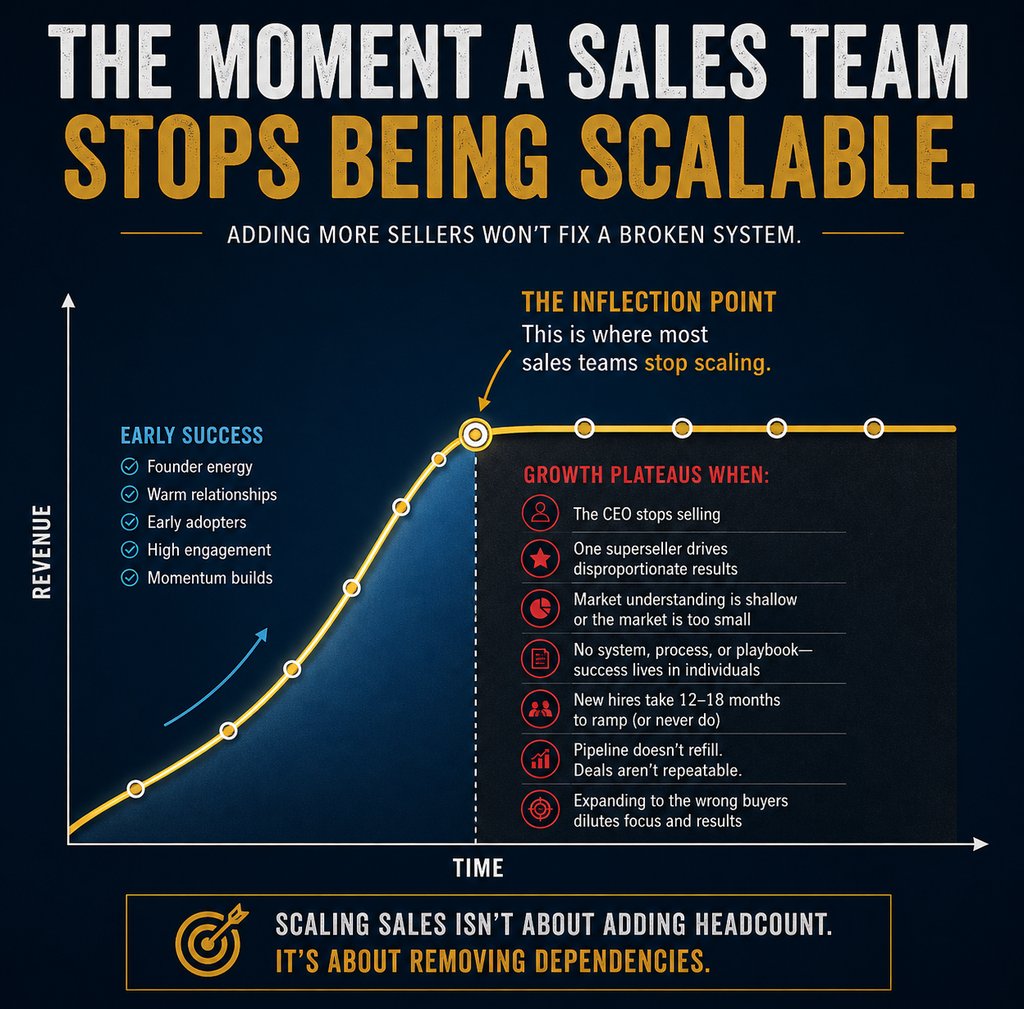
That’s the moment a sales team stops being scalable.
Most leaders don’t recognize it immediately. The instinct is to hire more people, increase activity, and assume output will follow. But if the system behind the team isn’t built to scale, more headcount doesn’t solve the problem. It amplifies it.
I’ve seen this show up in a few consistent ways.
In some cases, the CEO is the primary driver of revenue. Early deals come through relationships and founder credibility. The sales team is executing, but not generating. When the CEO steps away, pipeline disappears and the team stalls.
In other cases, there is a “superseller” dynamic. One individual drives a disproportionate share of the results. The team looks productive on paper, but in reality, they are supporting a single engine. When that person reaches capacity or leaves, growth stops.
Sometimes the issue is simpler. The team has figured out how to sell, but only through experience. There is no real playbook. No defined process. No system that a new hire can step into and execute. As a result, onboarding takes 12 to 18 months and scaling becomes slow and unpredictable.
And in some cases, the problem isn’t the team at all. The market simply isn’t there. The company has exhausted its early adopters or misjudged its total addressable market. At that point, no amount of hiring will create demand that doesn’t exist.
There are other signals as well. Pipeline that doesn’t refill consistently. Deals that are highly customized and difficult to replicate. Managers who are still the best sellers on the team. Expansion into new segments that dilute focus and reduce conversion.
All of these point to the same underlying issue.
Success isn’t transferable.
Scaling sales isn’t about adding headcount.
It’s about removing dependencies.
If your best results depend on specific people, specific deals, or specific circumstances, you don’t have a scalable system.
You have a fragile one.
Related Articles by Carter Cathey
About Carter Cathey
Carter Cathey is a sales and revenue leader with more than 20 years of experience helping market research, technology, and private-equity-backed businesses scale revenue, improve operations, and build predictable growth systems.
Throughout his career, he has led sales transformation initiatives, pricing strategy projects, subscription business model transitions, operational redesign efforts, and commercial growth programs.
He writes about leadership, organizational design, business systems, data-driven decision making, and the challenges companies face as they scale.
Learn more about Carter Cathey