
Data, Reporting, and Visibility: Why Organizations Measure What Is Easy Instead of What Matters
Organizations often measure what is easiest to capture rather than what is most important to understand. Over time, proxy metrics, incomplete data, and behavior-driven reporting gaps can create false confidence and distort decision-making. The real challenge is not simply collecting numbers—it is building measurement systems that accurately reflect operational reality, even when doing so requires difficult behavioral or process changes.
Carter Cathey
6/19/20262 min read
One of the most common problems I’ve seen inside organizations is not a lack of data.
It’s measuring the wrong things.
Or more specifically: measuring what is easiest instead of what actually matters.
I’ve seen this happen a few different ways over the years.
Sometimes a new executive joins the company and introduces metrics that were important in a previous business without fully examining whether those same measurements are operationally meaningful in the current environment.
Other times, organizations know exactly what they want to measure — but they cannot easily capture it.
So instead, they measure a nearby proxy metric because it already exists inside the system.
That’s where things often become dangerous.
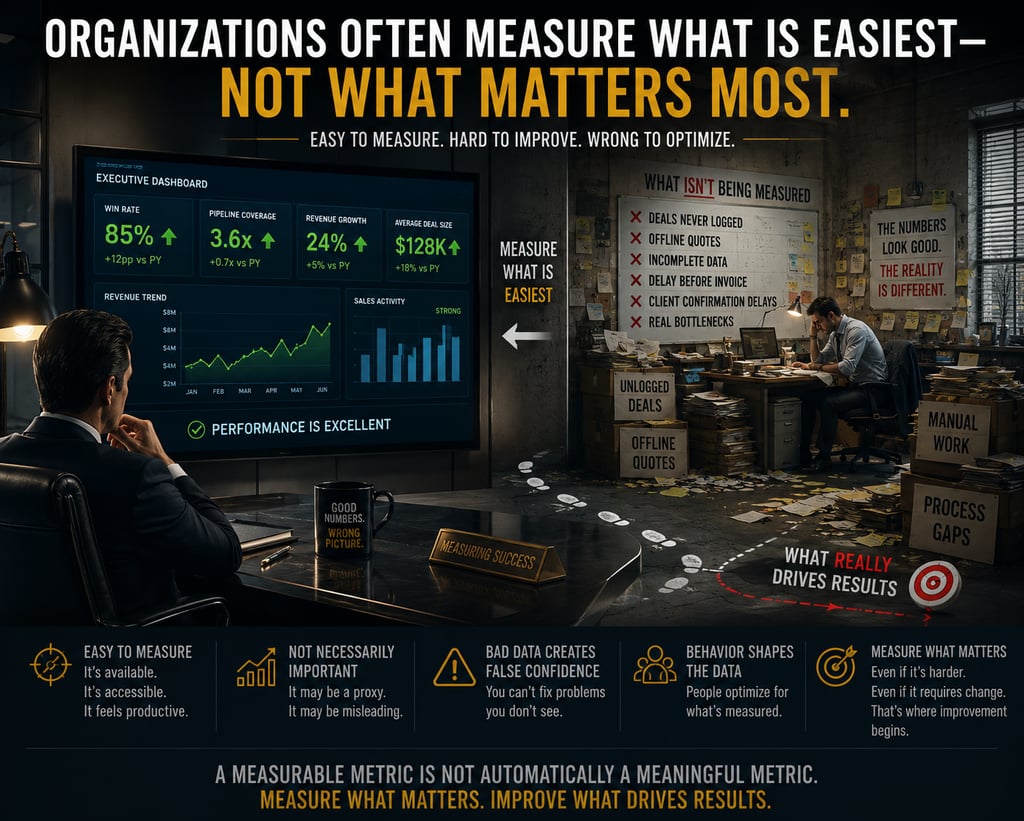
Because a measurable metric is not automatically a meaningful metric.
One example I encountered involved a company that believed win rate was one of its most important operational metrics.
That made sense conceptually.
The problem was how the data was actually being captured.
The company defined win rate as: wins divided by every opportunity created.
The result was an extremely high win rate — something around 85%.
At first glance, leadership thought this was fantastic.
But when I dug deeper, the reality was very different.
Many sellers were quoting projects offline and only logging opportunities into the CRM after they had already won them.
So the CRM wasn’t measuring actual opportunity conversion.
It was measuring selective reporting behavior.
The organization believed it had objective visibility into performance when in reality the data had become operationally meaningless.
And once leadership realized the problem, the conversation became even more interesting.
Instead of asking: “How do we improve process discipline so we can capture accurate data?”
The organization immediately started searching for alternative metrics because enforcing the behavioral changes required to collect good data felt operationally uncomfortable.
I saw something similar when a consultant recommended that we begin measuring invoice creation to payment timing because the company wanted to improve cash flow speed.
Again, the metric sounded reasonable.
The problem was that invoice payment timing was not the actual bottleneck in our business.
Our clients often delayed approving deliverables for weeks or months before invoices were even created.
So the real issue was not: invoice → payment
It was: delivery completion → invoice creation
The organization had visibility into the wrong part of the process.
And that’s one of the hidden dangers of poorly designed measurement systems.
Organizations often measure:
what already exists
what is easy to extract
what systems already capture
what doesn’t require behavioral change
Instead of measuring:
the real bottleneck
the real friction
the real operational constraint
But good measurement systems are not supposed to create comforting numbers.
They are supposed to create accurate understanding.
And sometimes the hardest part of analytics is not analysis.
It’s operational discipline.
Because measuring what truly matters often requires organizations to:
change behavior
improve compliance
redesign workflows
enforce process consistency
capture information differently
That work is uncomfortable.
But bad measurement creates false confidence.
And false confidence is far more dangerous than uncertainty.
The goal of reporting is not simply collecting numbers.
It’s accurately understanding operational reality.
Related Articles by Carter Cathey
About Carter Cathey
Carter Cathey is a sales and revenue leader with more than 20 years of experience helping market research, technology, and private-equity-backed businesses scale revenue, improve operations, and build predictable growth systems.
Throughout his career, he has led sales transformation initiatives, pricing strategy projects, subscription business model transitions, operational redesign efforts, and commercial growth programs.
He writes about leadership, organizational design, business systems, data-driven decision making, and the challenges companies face as they scale.
Learn more about Carter Cathey