
Success Can Hide Broken Systems
Companies often recognize broken systems only after growth stalls, but many operate with flawed systems while still succeeding. Strong growth can mask inefficiencies, allow underperformance to go unnoticed, and reward individuals who succeed despite the system rather than because of it. True system health is revealed not by outcomes alone, but by how consistently success can be replicated across the organization.
Carter Cathey
5/20/20262 min read
Most people think broken systems are easy to spot.
Growth stalls.
Performance declines.
What used to work stops working.
Those are obvious signals.
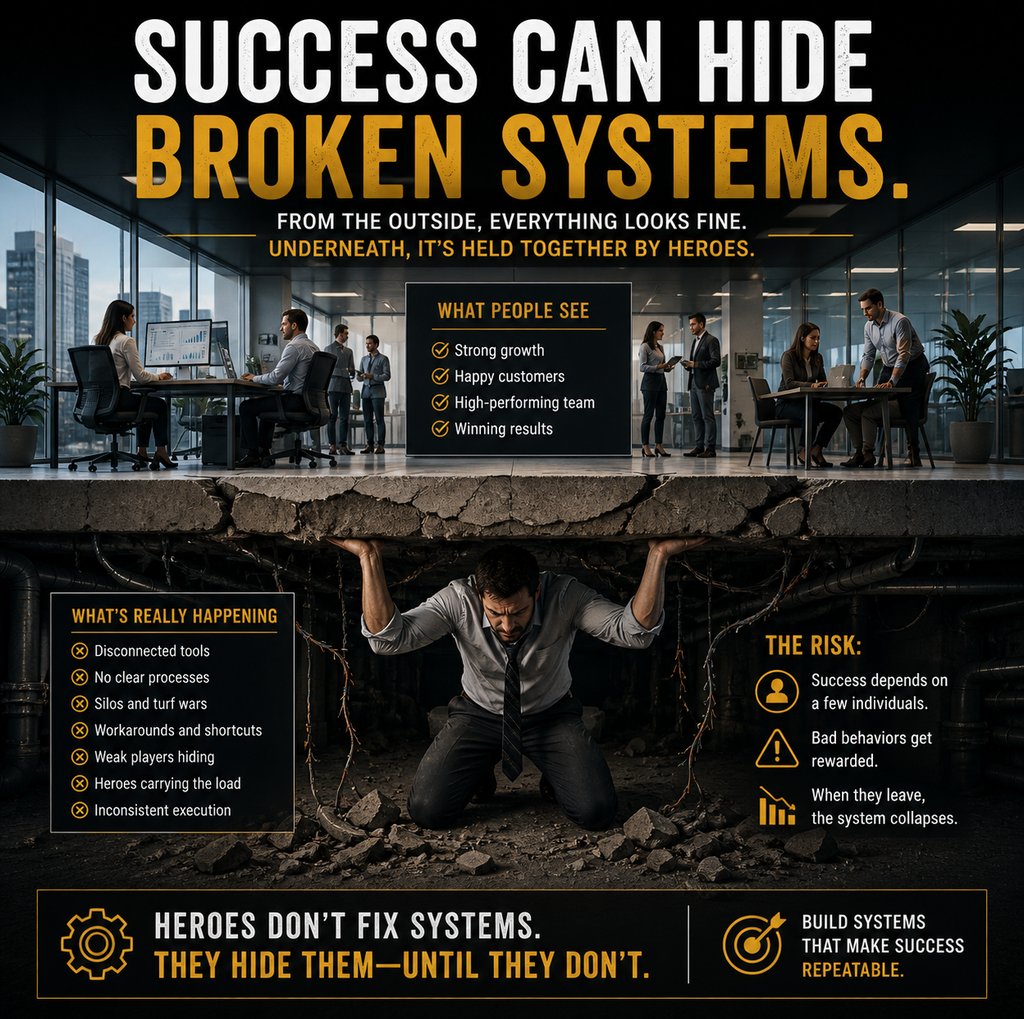
What’s less obvious is that many companies operate with broken systems while still being successful.
In fact, success can hide the problem.
When a company is growing quickly, there is less scrutiny on how results are actually being produced. There is enough demand, enough momentum, and enough activity that outcomes look strong from the outside.
Underneath that, a different reality can exist.
Weak performance is harder to see. People can hit numbers by supporting deals that would have closed anyway. Functions can underperform without immediate consequences because the system is carrying them.
There is room to hide.
The same dynamic shows up with top performers.
In strong systems, success is typically the result of repeatable behaviors. In broken systems, success often comes from people working around the system.
They learn what to ignore.
They learn where the shortcuts are.
They learn how to get things done despite the structure in place.
Over time, those individuals can become the “heroes” of the organization.
They are the ones who get results.
They are the ones others rely on.
They are the ones leadership points to as examples of success.
But their success isn’t coming from the system.
It’s coming from their ability to navigate around it.
In some cases, the wrong people become heroes. Individuals who are willing to push through friction, bypass process, and impose their will can outperform in broken environments. And when those results are rewarded, the organization starts to reinforce behavior that doesn’t scale.
That’s where the real risk sits.
Because when growth slows, when demand tightens, or when those individuals leave, the gap between the system and the outcome becomes very clear.
The system was never producing the results.
The people were.
Healthy systems don’t depend on heroes.
They make success repeatable.
Related Articles by Carter Cathey
About Carter Cathey
Carter Cathey is a sales and revenue leader with more than 20 years of experience helping market research, technology, and private-equity-backed businesses scale revenue, improve operations, and build predictable growth systems.
Throughout his career, he has led sales transformation initiatives, pricing strategy projects, subscription business model transitions, operational redesign efforts, and commercial growth programs.
He writes about leadership, organizational design, business systems, data-driven decision making, and the challenges companies face as they scale.
Learn more about Carter Cathey