
How Systems Work: Why Repeatability Is the Real Product of Operations
Organizations often mistake isolated success for operational effectiveness, especially during periods of growth. In many cases, strong individuals compensate for weak systems through workarounds, tribal knowledge, or extraordinary effort, creating the illusion that processes are functioning well. Operational maturity is not measured by whether one exceptional person can succeed, but by whether success becomes consistently repeatable across the organization without requiring heroics.
Carter Cathey
6/12/20262 min read
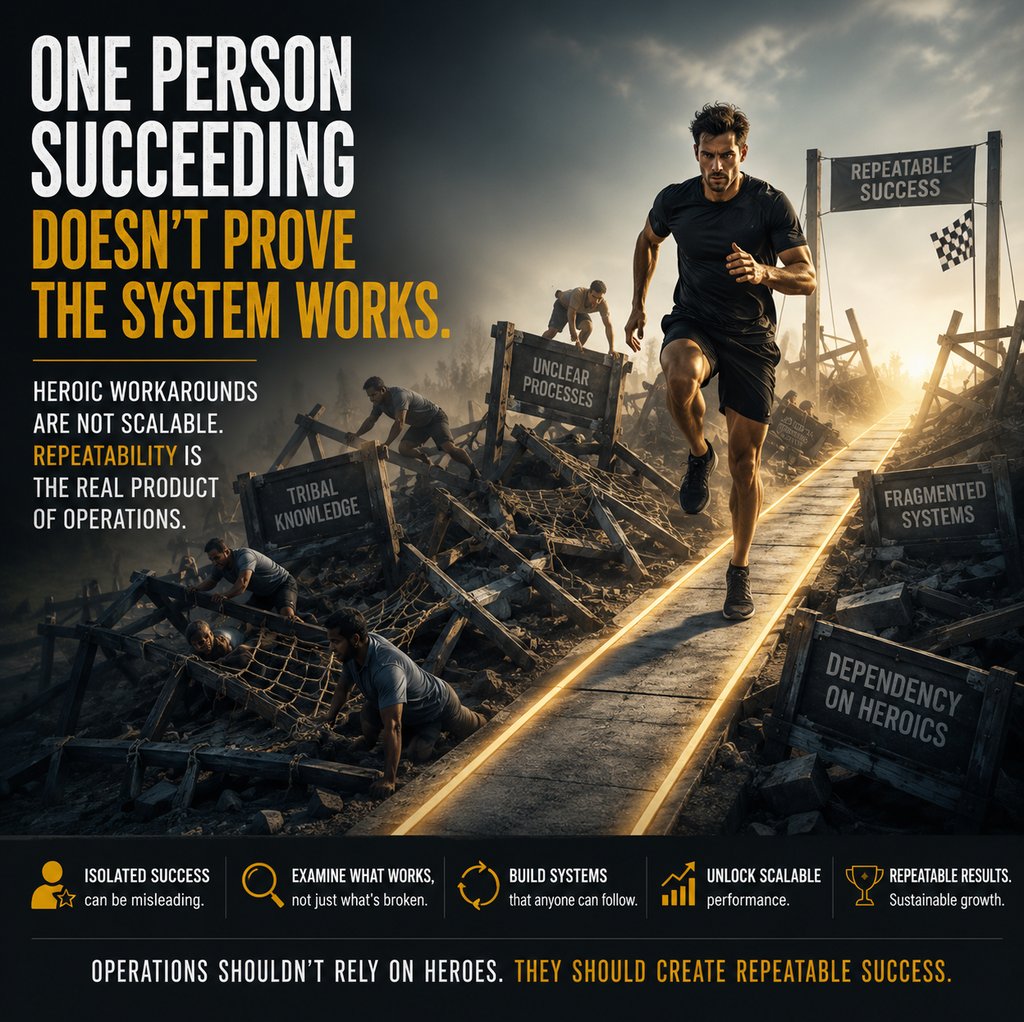

One of the biggest operational mistakes companies make is assuming that because something is currently successful, the underlying system must be working.
I’ve seen this repeatedly inside growing organizations.
A team hits its numbers.
A seller consistently performs.
A department appears productive.
And leadership’s response becomes: “If it isn’t broken, why fix it?”
The problem is that success can exist despite the system, not because of it.
Sometimes what organizations interpret as operational excellence is really just a single person who has figured out how to work around broken processes, fragmented systems, or inefficient tooling.
The organization sees the outcome.
What it doesn’t see is the hidden friction required to produce it.
And this creates one of the most dangerous operational blind spots in business.
Because operations are not supposed to produce isolated success stories.
They are supposed to produce repeatable success.
That’s a very different thing.
A process that depends heavily on:
tribal knowledge
heroic effort
workarounds
exceptional individuals
…is not a scalable process.
It’s a fragile one.
I think companies often evaluate systems against failure instead of against potential.
The question becomes: “Is this working?”
Instead of: “How much is this system limiting what we could become?”
That distinction matters enormously.
I’ve seen organizations where teams were technically successful, but the amount of friction inside the process was enormous.
The people succeeding inside those systems were succeeding because they had learned:
who to call
what shortcuts to take
which approvals to bypass
how to manually compensate for operational weakness
Leadership interpreted this as proof that the system worked.
In reality, the organization had become dependent on heroic adaptation.
And heroic adaptation does not scale well.
The real test of a system is not whether one exceptional person can succeed inside it.
It’s whether average capable people can succeed consistently within it.
That’s what operational maturity actually looks like.
The other challenge is that organizations often only examine the things that are visibly on fire.
But operational inefficiency rarely announces itself dramatically.
More often, it quietly taxes productivity, slows scale, increases dependency risk, and limits organizational potential for years before anyone fully notices.
Mature operators understand this.
They don’t wait for visible failure before improving systems.
They continuously examine:
workflow friction
repeatability
scalability
dependency risk
hidden manual effort
Even when current outcomes appear successful.
Because the goal of operations is not proving that success is possible.
It’s making success consistently repeatable without requiring heroics.
Related Articles by Carter Cathey
About Carter Cathey
Carter Cathey is a sales and revenue leader with more than 20 years of experience helping market research, technology, and private-equity-backed businesses scale revenue, improve operations, and build predictable growth systems.
Throughout his career, he has led sales transformation initiatives, pricing strategy projects, subscription business model transitions, operational redesign efforts, and commercial growth programs.
He writes about leadership, organizational design, business systems, data-driven decision making, and the challenges companies face as they scale.
Learn more about Carter Cathey