The New Leadership Skill: Communication Mode Allocation
Modern workplace communication has become increasingly fragmented across messaging platforms, dashboards, email, meetings, project tools, and asynchronous workflows. This shift is not inherently negative, but it changes how leaders must think about communication, alignment, and engagement. Effective leadership communication today is less about maximizing communication volume and more about intentionally investing communication where human interaction creates the most value.
Carter Cathey
5/27/20262 min read
I recently read a study showing that people speak 28% fewer words per day than they did twenty years ago.
I don’t think that observation is inherently good or bad.
What it clearly reflects is that communication (both workplace and personal) has become far more fragmented.
Twenty years ago, most business communication happened through a relatively small number of channels:
meetings
phone calls
face-to-face conversations
email
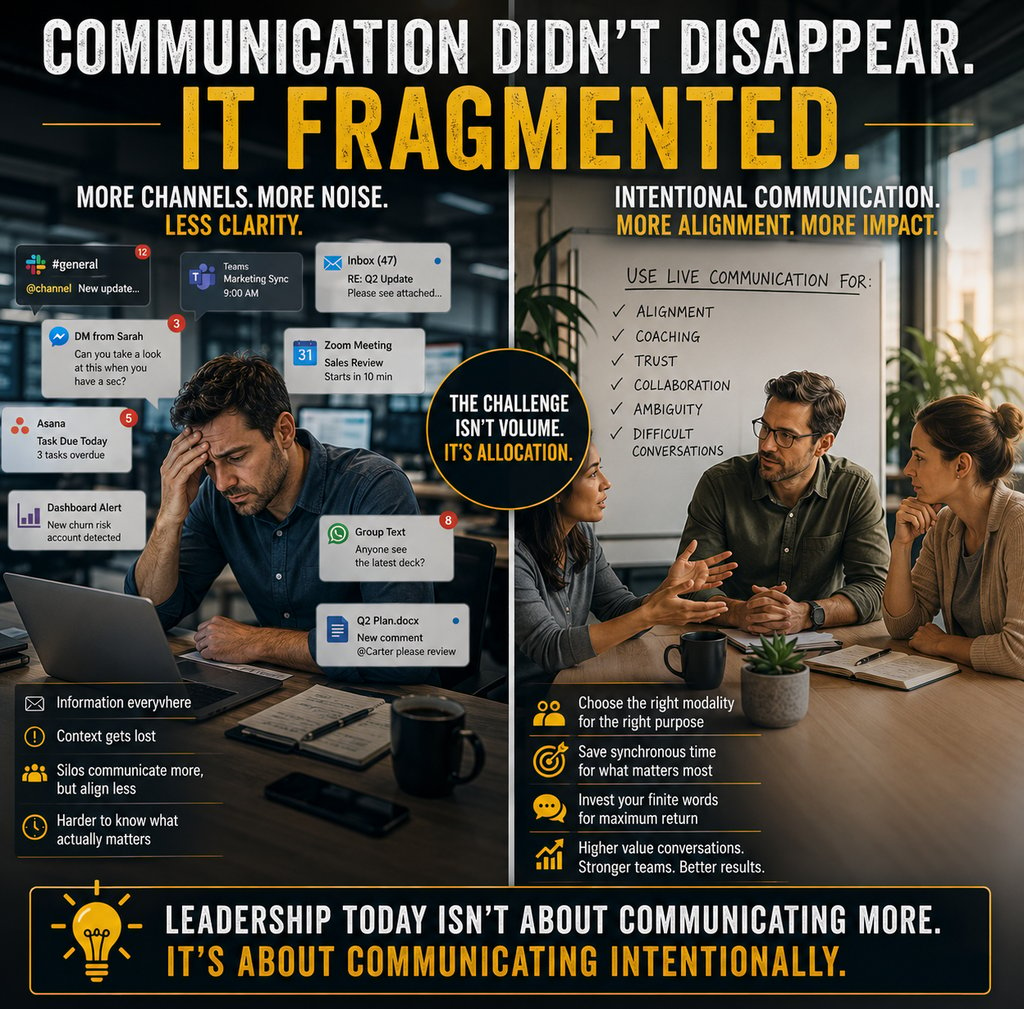
Today, communication is spread across Slack, Teams, Zoom, text, dashboards, project tools, email, CRM notes, comments, and countless other channels.
Communication didn’t disappear.
It fragmented.
And that fragmentation changes the role of leadership communication.
I don’t think the solution is to force organizations back into constant meetings or long face-to-face discussions. In fact, I think it suggests that the appetite for talking about every topic has vastly declined. Modern communication tools have made organizations faster and more efficient.
Not every update deserves a meeting.
Not every discussion requires live interaction.
Not every status review needs thirty minutes on a calendar.
In fact, many leaders still spend too much synchronous communication on information that could have been consumed asynchronously.
But fragmentation creates its own challenges.
Context becomes scattered.
Nuance gets lost.
Visibility becomes inconsistent.
Teams communicate heavily within functions but less across them.
And because communication is spread across so many channels, it becomes harder for leaders to determine where attention and engagement should actually be focused.
I think this changes the leadership challenge.
The goal is no longer maximizing communication volume.
It’s maximizing communication value.
Leaders now have to think much more intentionally about communication mode allocation.
What should be asynchronous?
What requires live discussion?
Where does human interaction create the most value?
Because the value of live communication has changed.
Live interaction is no longer the most efficient way to distribute information.
It’s most valuable for:
alignment
coaching
trust
difficult conversations
collaboration
ambiguity
emotional connection
Ironically, because those interactions happen less frequently now, they may actually matter more than they used to.
Communication is no longer scarce.
Attention and context are.
Leaders who treat every topic like it deserves a meeting create disengagement.
Leaders who rely entirely on fragmented async communication create organizational drift.
The goal isn’t more communication.
It’s more intentional communication.
Related Articles by Carter Cathey
About Carter Cathey
Carter Cathey is a sales and revenue leader with more than 20 years of experience helping market research, technology, and private-equity-backed businesses scale revenue, improve operations, and build predictable growth systems.
Throughout his career, he has led sales transformation initiatives, pricing strategy projects, subscription business model transitions, operational redesign efforts, and commercial growth programs.
He writes about leadership, organizational design, business systems, data-driven decision making, and the challenges companies face as they scale.
Learn more about Carter Cathey