
Growth & Scaling: The Moment Communication Stops Scaling
Many early-stage companies mistake proximity for alignment. When teams sit together, hear the same conversations, and solve problems in real time, formal systems often seem unnecessary. The challenge comes when growth separates people, because communication that worked naturally at small scale rarely scales with the organization.
Carter Cathey
7/3/20262 min read
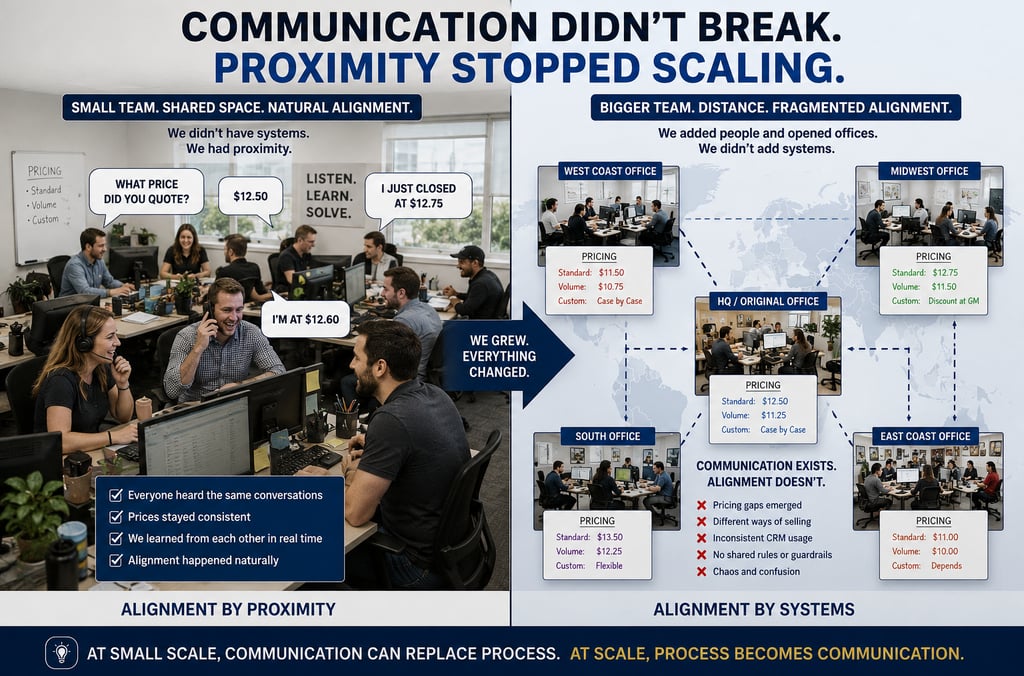
When I started at a small Market Research firm, the sales team was small enough that I could practically throw a pen and hit most of the department. We all sat together. We heard each other's calls. We listened to negotiations. We discussed pricing.
If someone yelled across the room: "What are you quoting for this?" Three or four people would immediately respond. And most of the answers would be surprisingly close.
At the time, we thought we had a highly aligned sales organization. Looking back, I realize something different was happening. We weren't aligned because we had great systems. We were aligned because we sat together. Twelve hours a day. Five days a week. Everyone heard the same conversations. Everyone learned from the same examples. Everyone absorbed the same unwritten rules.
What felt like operational maturity was often just proximity.
Then we grew. And we grew fast. A few years later we had hundreds of salespeople across multiple offices. We couldn't fit everyone into the same meeting room anymore.
Instead of one sales meeting, we had:
division meetings
regional meetings
team meetings
At first this seemed perfectly reasonable. But something interesting happened. The teams stayed aligned internally. The organization stopped being aligned externally. Pricing began to drift. Different groups developed different selling approaches. CRM practices varied dramatically. Teams interpreted policies differently. In some cases, people were effectively selling different products.
Communication still existed. Alignment didn't.
And that's when I learned an important lesson:
Communication didn't break. Proximity stopped scaling.
When companies are small, communication can often replace process.
Knowledge lives in:
conversations
observations
relationships
shared experiences
But as organizations grow, knowledge has to move into systems. Because eventually people can no longer hear the same conversations. They can't absorb information through proximity. They can't rely on informal alignment.
That's when organizations need:
business rules
documented processes
CRM governance
pricing frameworks
shared operating principles
Not because bureaucracy is good. But because communication eventually reaches its limits. At small scale, communication can replace process. At large scale, process becomes communication.
And one of the most important transitions a growing company can make is recognizing the moment proximity stops creating alignment.
Because what worked when everyone sat within earshot rarely works when everyone sits in different offices.
Related Articles by Carter Cathey
About Carter Cathey
Carter Cathey is a sales and revenue leader with more than 20 years of experience helping market research, technology, and private-equity-backed businesses scale revenue, improve operations, and build predictable growth systems.
Throughout his career, he has led sales transformation initiatives, pricing strategy projects, subscription business model transitions, operational redesign efforts, and commercial growth programs.
He writes about leadership, organizational design, business systems, data-driven decision making, and the challenges companies face as they scale.
Learn more about Carter Cathey