
Why Growth Breaks When Nothing Is Written Down
Undocumented systems can function effectively in early-stage companies where proximity and shared context drive execution. However, as organizations grow, the lack of documented processes and structured communication leads to inconsistent execution, slower onboarding, and fragmented decision-making. Scaling requires not just hiring more people, but creating systems that transfer knowledge and maintain alignment across teams.
Carter Cathey
5/25/20262 min read
Undocumented systems work.
At least for a while.
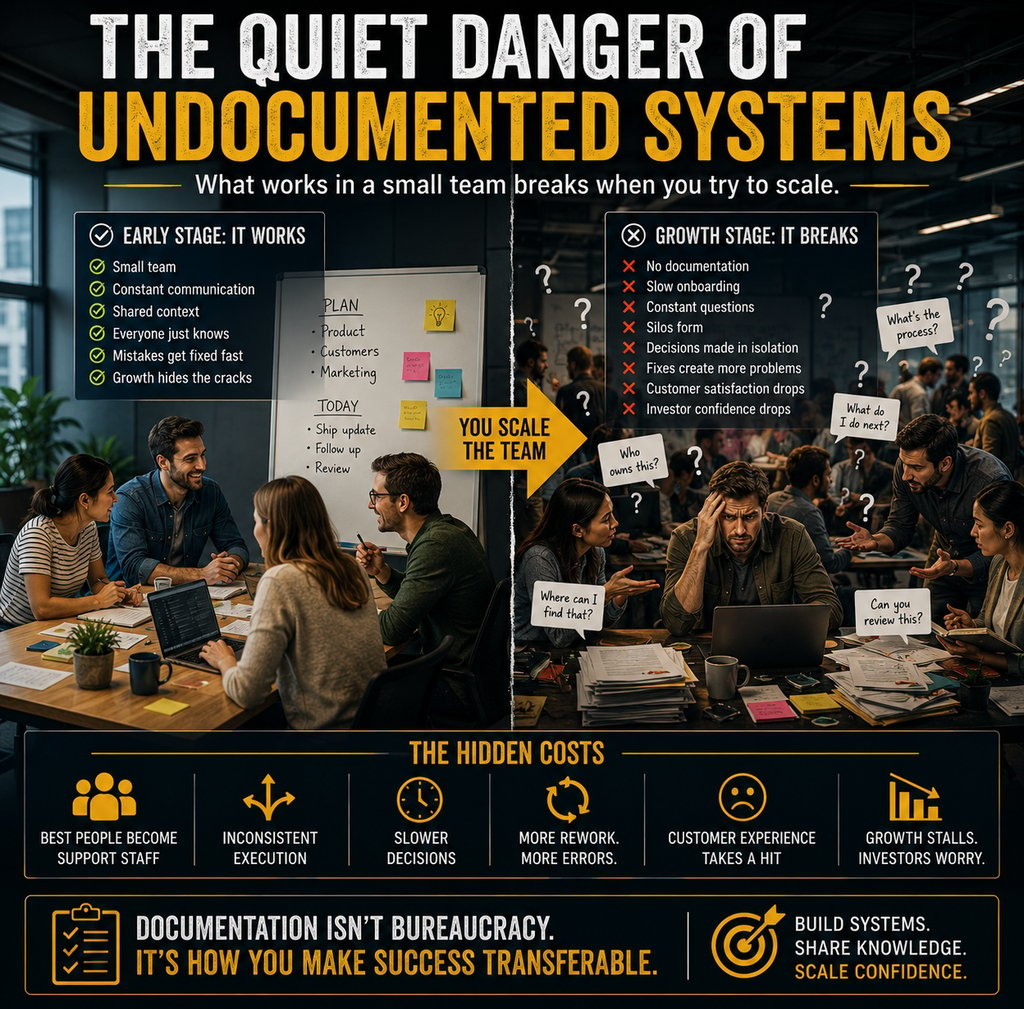
In the early stages of a company, everything is close. The team is small. Communication is constant. People don’t need documentation because they were there when things were built. They understand what to do, when to do it, and how to do it.
Mistakes happen, but they get fixed quickly. Growth masks inefficiency.
From the outside, it looks like the system works.
Then the company grows.
You hire more people. Teams expand. Functions form. And the environment that made undocumented systems work starts to disappear.
New hires don’t have the same context. They weren’t there when decisions were made. They don’t intuitively know how things work.
And there’s nothing written down to guide them.
So they ask questions.
A lot of questions.
They rely on experienced employees for direction. Those employees get pulled away from their work to support others. Over time, your highest performers become your support system.
At the same time, execution starts to diverge.
When systems aren’t documented, every new hire creates a slightly different version of the process. What was once consistent becomes fragmented. Customer experience becomes inconsistent. Quality varies.
Speed slows down.
There’s another layer to this that shows up as the organization grows.
In the early days, communication is organic. Everyone knows what’s happening because they are close to it.
As the company grows, that breaks.
Teams get bigger. Silos form. Communication shifts from shared context to fragmented conversations within functions.
And without a structured way for teams to align, each group starts solving problems in isolation.
They move fast, but without shared context.
And in many cases, those decisions create more problems than they solve.
What used to be alignment through proximity now requires alignment through process.
If that process doesn’t exist, communication becomes reactive, inconsistent, and inefficient.
This is when things start to break.
Onboarding slows.
Execution becomes inconsistent.
Decisions take longer.
Customers feel the difference.
Investors start asking questions.
The instinct is to hire more people to fix it.
But hiring into an undocumented system doesn’t create leverage.
It creates complexity.
Undocumented systems don’t fail immediately.
They fail the moment you try to scale them.
If success lives in people’s heads, it can’t be transferred.
And if it can’t be transferred, it can’t scale.
Related Articles by Carter Cathey
About Carter Cathey
Carter Cathey is a sales and revenue leader with more than 20 years of experience helping market research, technology, and private-equity-backed businesses scale revenue, improve operations, and build predictable growth systems.
Throughout his career, he has led sales transformation initiatives, pricing strategy projects, subscription business model transitions, operational redesign efforts, and commercial growth programs.
He writes about leadership, organizational design, business systems, data-driven decision making, and the challenges companies face as they scale.
Learn more about Carter Cathey