
The Wrong Metric Doesn't Just Give You the Wrong Data. It Gives You the Wrong Direction.
Metrics do more than measure behavior—they shape it. When organizations attach incentives, recognition, or compensation to the wrong metrics, employees naturally optimize for the measurement rather than the desired outcome. The challenge is not simply choosing metrics that can be tracked, but choosing metrics that create the behaviors the business actually wants.
Carter Cathey
6/24/20262 min read
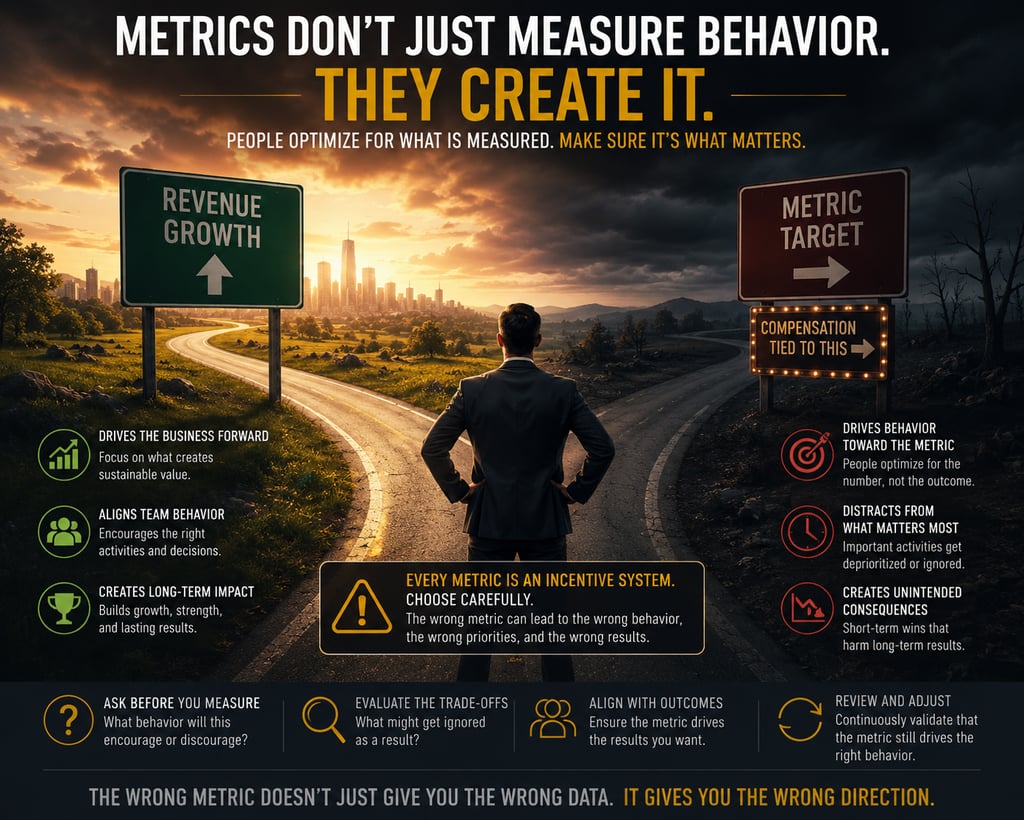
One of the most dangerous assumptions organizations make is believing that metrics simply measure behavior.
They don't.
Metrics create behavior.
The moment a metric becomes visible, discussed, tracked, rewarded, or tied to compensation, it begins influencing how people spend their time and attention.
That's not a bad thing.
In fact, that's often the entire point.
The challenge is making sure the behavior being encouraged actually supports the outcome the business wants.
I learned this lesson firsthand when a company I worked for was struggling with late payments and cash flow challenges.
Leadership decided to create a metric tied to how quickly clients paid after project completion.
The metric was attached to variable compensation for the sales team.
The result?
The metric worked.
Salespeople spent far more time:
following up on invoices
working with finance
contacting clients about payment issues
pushing for collections activity
Some even began delaying new projects until older invoices were paid.
The amount of unpaid receivables declined.
The metric achieved its objective.
But something else happened.
Salespeople started spending less time selling.
More time was spent managing collections activity and less time was spent creating new opportunities, developing relationships, and generating revenue.
Sales declined.
The metric wasn't ignored.
It was taken seriously.
And that's what made it dangerous.
Because the company wanted two things:
faster collections
continued sales growth
But the incentive structure elevated collections activity above revenue generation.
The sales team simply optimized for what leadership told them was important.
That's why organizations should never evaluate a metric by asking: "Can we measure this?"
Instead, they should ask: "What behavior will this create?"
Every metric is also an incentive system.
Every KPI creates priorities.
Every compensation plan changes behavior.
And every measurement system creates trade-offs.
The best metrics align behavior with outcomes.
The worst metrics force employees to choose between them.
Because the wrong metric doesn't just give you the wrong data.
It can give you the wrong direction.
Related Articles by Carter Cathey
About Carter Cathey
Carter Cathey is a sales and revenue leader with more than 20 years of experience helping market research, technology, and private-equity-backed businesses scale revenue, improve operations, and build predictable growth systems.
Throughout his career, he has led sales transformation initiatives, pricing strategy projects, subscription business model transitions, operational redesign efforts, and commercial growth programs.
He writes about leadership, organizational design, business systems, data-driven decision making, and the challenges companies face as they scale.
Learn more about Carter Cathey