
Reporting Is Not the Same Thing as Understanding
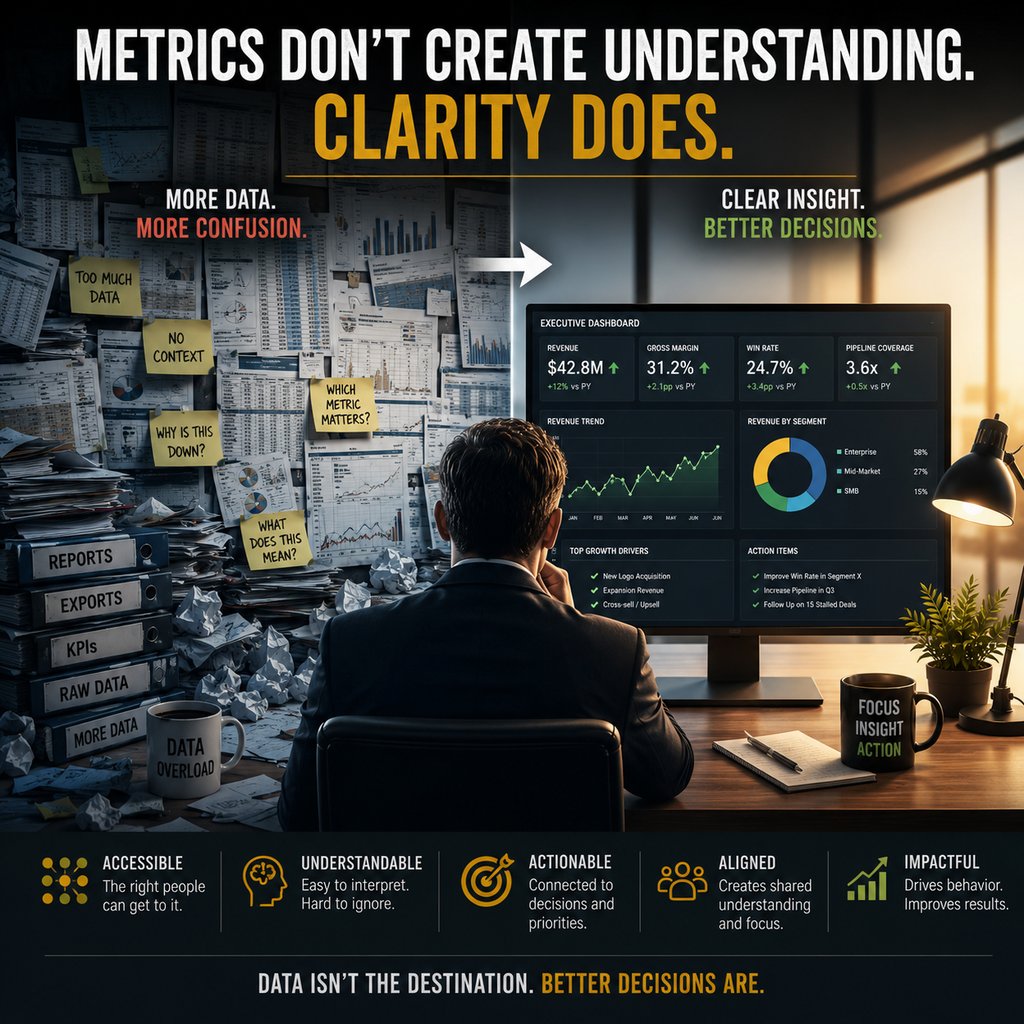
Data alone does not create organizational clarity. Metrics only become valuable when they are accessible, understandable, and connected to decisions, behaviors, and outcomes. The most effective reporting systems do more than measure activity—they create shared understanding and help organizations align around what actually matters.
Carter Cathey
6/15/20262 min read
A lot of organizations talk about becoming more data-driven.
But one of the things I’ve learned over the years is that collecting data and creating understanding are not the same thing.
The best data in the world has very little value if people:
can’t access it
don’t understand it
don’t trust it
or don’t know how to act on it
I worked with a colleague years ago who was exceptionally good at data visualization.
One of the things he emphasized constantly was that reporting should make information more understandable than simply looking at raw data itself.
That’s an important distinction.
Because many organizations accidentally confuse:
dashboards
spreadsheets
reports
KPI tracking
…with actual operational clarity.
But overwhelming people with metrics rarely creates alignment.
In many cases, it creates noise.
Good reporting reduces ambiguity.
Great reporting changes behavior.
And that only happens when organizations connect metrics to:
decisions
priorities
workflows
incentives
outcomes
The best reporting systems don’t just measure performance.
They help organizations understand:
what matters
why it matters
what is improving
what is declining
what actions should follow
That’s where reporting becomes operationally valuable.
I think a lot of companies underestimate how much work is required to operationalize metrics effectively.
Metrics are not self-explanatory culturally.
Organizations have to:
socialize them
reinforce them
explain them
connect them to everyday decisions
create shared understanding around them
Otherwise reporting simply becomes passive documentation.
A metric nobody understands cannot meaningfully influence behavior.
And data itself is not the destination.
Better decisions are the destination.
Better execution is the destination.
Better outcomes are the destination.
Data is simply one of the ingredients required to get there.
The organizations that use reporting most effectively are usually not the ones with the most dashboards.
They’re the ones that create the clearest understanding.
Because reporting is not the same thing as understanding.
And metrics only become valuable when they help organizations act more intelligently.
Related Articles by Carter Cathey
About Carter Cathey
Carter Cathey is a sales and revenue leader with more than 20 years of experience helping market research, technology, and private-equity-backed businesses scale revenue, improve operations, and build predictable growth systems.
Throughout his career, he has led sales transformation initiatives, pricing strategy projects, subscription business model transitions, operational redesign efforts, and commercial growth programs.
He writes about leadership, organizational design, business systems, data-driven decision making, and the challenges companies face as they scale.
Learn more about Carter Cathey