When Expensive Talent Gets Trapped in Low-Value Work
Many growing companies unintentionally consume expensive talent with transactional, low-leverage work because systems, specialization, and operational support never evolve alongside growth. Teams remain busy and productive on the surface, but organizations quietly lose strategic capacity as highly skilled employees spend most of their time on tasks far below their economic value. Scaling effectively requires redesigning how work flows through the organization, not simply adding more high-cost talent.
Carter Cathey
6/10/20262 min read
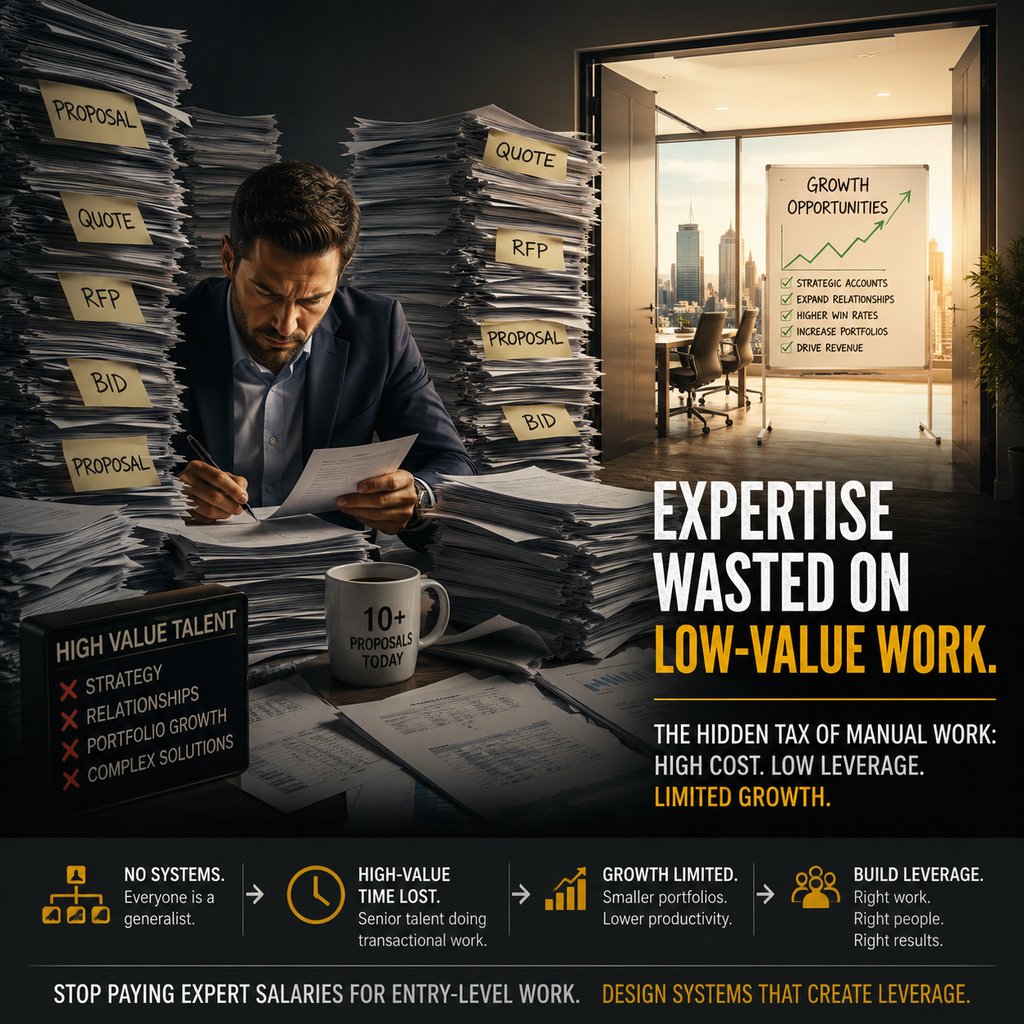

One of the hidden operational taxes inside growing companies is manual work.
Not because manual work itself is inherently bad.
But because organizations often fail to think carefully about who is performing it.
I’ve seen this repeatedly inside scaling sales organizations.
Early on, companies often have:
two to four sellers
little support infrastructure
minimal process
very few specialized roles
Everybody functions as a generalist.
And honestly, that works extremely well at small scale.
Those early sellers are often highly adaptable people who figure things out through sheer effort and flexibility. They drive the early revenue that allows the business to grow.
But then the company decides to scale.
Instead of redesigning the operating model, the organization simply hires more sellers into the exact same structure.
Suddenly you have:
twenty sellers
no real systems
minimal operational support
fragmented processes
everybody doing everything
At first glance, it feels efficient because you avoid adding “extra” support roles.
But over time, something much more expensive starts happening.
You hire experienced, mid-career sellers because of their ability to:
navigate complex client relationships
understand sophisticated customer needs
position solutions strategically
drive high-value commercial conversations
Then you consume most of their day with transactional work.
I saw this firsthand in one organization.
As the company became larger and more well known, proposal volume exploded. We were invited to quote on far more projects than before.
That sounded like growth.
But the win rate dropped significantly.
Which meant our senior sellers suddenly spent enormous amounts of time producing proposals.
At one point, we had highly compensated sellers creating ten or more proposals per day.
These were talented people earning $200k+ because of their commercial judgment, industry expertise, and client management capabilities.
Yet they were spending most of their day producing quotes.
Not strategy.
Not relationship building.
Not portfolio expansion.
Not complex selling.
Quotes.
The organization saw adding support staff as purely additive cost.
What it failed to recognize was that we had already created an incredibly expensive support organization.
It just happened to be disguised as a sales team.
Eventually, I proposed building a dedicated support function focused on proposal generation and tactical execution.
The initial reaction was panic over cost.
But a few years later, we had built a team of more than one hundred support professionals handling proposal creation, and nobody could imagine going back.
Because once the tactical workload was removed, our senior commercial people became dramatically more productive.
Their portfolios grew significantly larger.
Their client engagement improved.
Their strategic capacity increased.
And importantly, the number of senior sellers required per dollar of revenue dropped substantially.
The organization didn’t become more expensive.
It became more economically efficient.
That’s the hidden tax of manual work.
Organizations often measure:
effort
utilization
activity
But they rarely ask: “Is this work being performed at the correct economic layer of the organization?”
Busy teams are not always optimized teams.
And one of the biggest scaling mistakes companies make is assuming that eliminating support roles reduces cost.
Very often, it simply redistributes lower-value work upward into increasingly expensive layers of the business.
The hidden tax isn’t just inefficiency.
It’s the slow erosion of strategic capacity.
Related Articles by Carter Cathey
About Carter Cathey
Carter Cathey is a sales and revenue leader with more than 20 years of experience helping market research, technology, and private-equity-backed businesses scale revenue, improve operations, and build predictable growth systems.
Throughout his career, he has led sales transformation initiatives, pricing strategy projects, subscription business model transitions, operational redesign efforts, and commercial growth programs.
He writes about leadership, organizational design, business systems, data-driven decision making, and the challenges companies face as they scale.
Learn more about Carter Cathey