How Systems Work: When the Founder Becomes the Bottleneck
Many of the traits that allow founders to successfully build companies in the early stages can later become constraints on organizational growth. As companies scale, centralized decision-making eventually limits speed, leadership development, and operational capacity. Sustainable growth requires founders to evolve from personally driving decisions to building systems and leaders capable of making decisions without them.
Carter Cathey
6/1/20262 min read
I have a tremendous amount of respect for founders.
Most people around them tell them not to take the risk. The odds are against them. Resources are limited. The path is unclear.
And yet, they build something anyway.
In many cases, the company exists because of the founder’s sheer determination to force it into existence.
In the early stages, this works incredibly well.
The founder makes every decision.
Nothing ships without their approval.
Every detail reflects their judgment, standards, and instincts.
And honestly, that level of involvement is often necessary.
Early-stage companies don’t survive because they have perfect systems.
They survive because founders compensate for weak systems through sheer force of will.
But eventually, if things go well, the company grows.
You now have hundreds of employees. Multiple departments. Layers of leadership. Increasing complexity.
What often doesn’t change is the founder’s desire to remain deeply involved in nearly every important decision.
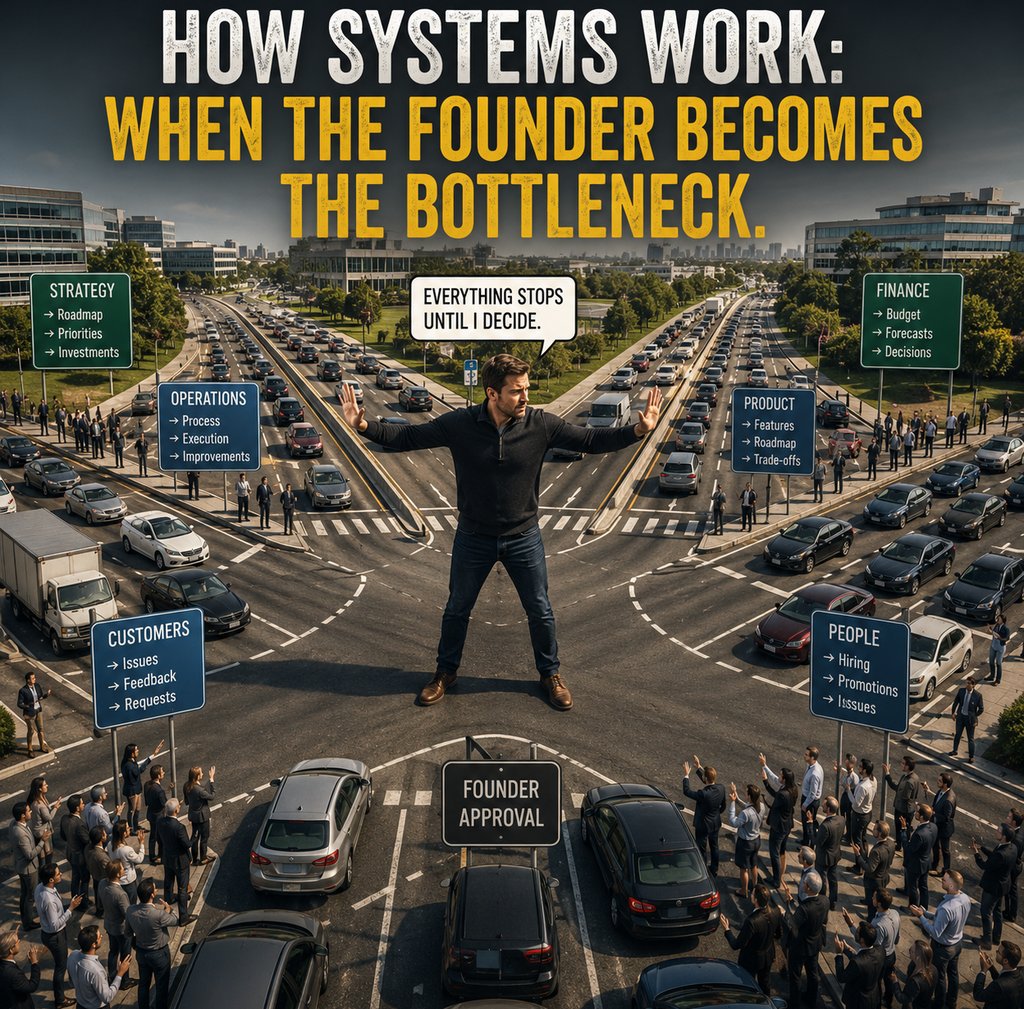
This is where the founder can unintentionally become the bottleneck.
At ten employees, centralized decision-making creates speed and alignment.
At a few hundred employees, it creates queues.
Everything waits:
approvals
priorities
hiring decisions
pricing decisions
product trade-offs
strategic direction
The organization stops scaling at the speed of the market and starts scaling at the speed of the founder’s availability.
And this is an incredibly difficult transition psychologically.
Because the founder is often right.
They do understand the business better than most people around them. They do have better instincts than many newer leaders. They do recognize risks others may miss.
They also know something else:
Other people will make mistakes.
They will make decisions differently.
They will occasionally make worse decisions.
That’s inevitable.
But scaling a company requires leaders to accept something uncomfortable:
Distributed decision-making is less perfect, but far more scalable.
This is the transition from founder to CEO.
The founder builds the company through personal involvement and force of will.
The CEO builds systems, leaders, and decision-making structures that allow the organization to operate effectively without constant founder intervention.
That’s a very different job.
And honestly, it’s one of the hardest mindset shifts in business.
Because the goal of scaling isn’t to make the founder irrelevant.
It’s to make the organization capable.
Great founders create companies through determination and personal intensity.
Great CEOs create organizations that no longer depend entirely on either.
Related Articles by Carter Cathey
About Carter Cathey
Carter Cathey is a sales and revenue leader with more than 20 years of experience helping market research, technology, and private-equity-backed businesses scale revenue, improve operations, and build predictable growth systems.
Throughout his career, he has led sales transformation initiatives, pricing strategy projects, subscription business model transitions, operational redesign efforts, and commercial growth programs.
He writes about leadership, organizational design, business systems, data-driven decision making, and the challenges companies face as they scale.
Learn more about Carter Cathey