
Data, Reporting, and Visibility: The Difference Between Data Collection and Insight
Many organizations collect enormous amounts of data but generate very little insight. Data becomes valuable only when it changes understanding, influences decisions, or drives action. The goal isn't to accumulate information—it's to transform information into better decisions and better outcomes.
Carter Cathey
6/29/20262 min read
I've spent more than 20 years working in the insights industry. One of the things I've learned is that data collection and insight generation are not the same thing even though many organizations assume they are.
They're not.
Data is an input. Insight is an output. And there are a surprising number of organizations collecting inputs without producing meaningful outputs. Part of the challenge is that not all data collection is intended to create understanding.
I've seen data collected:
to support a decision that was already made
to strengthen an existing point of view
to defend a past decision that didn't go well
because someone believes "serious companies" should be collecting it
because it was important at a previous company
In each case, data is being gathered. But insight is not necessarily being created.
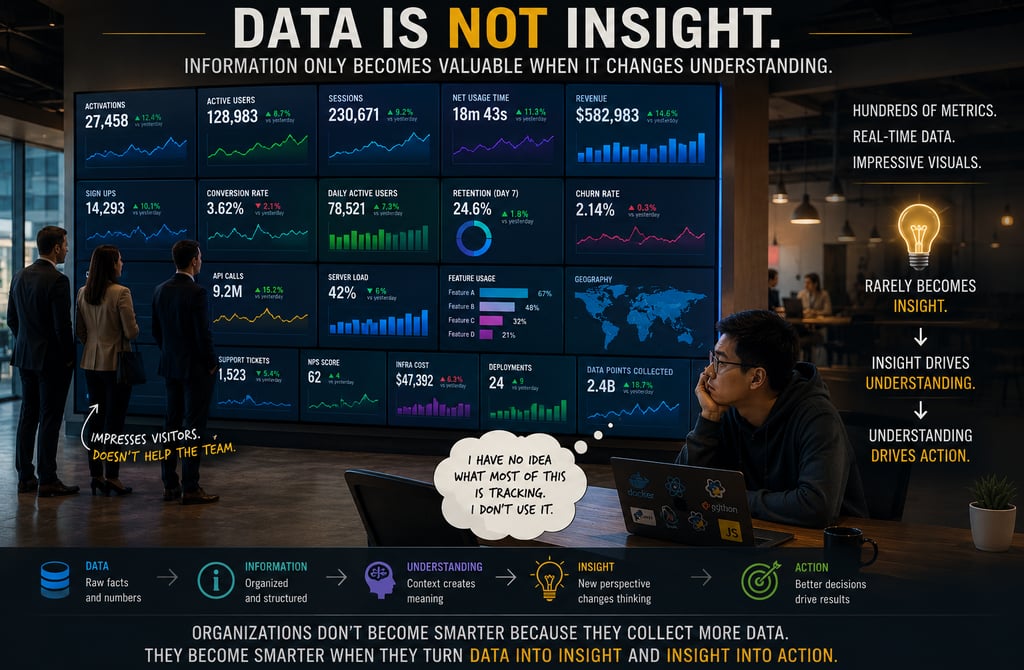
Years ago, I visited a startup in Silicon Valley. They had enormous monitors mounted throughout the office displaying real-time metrics.
Activations
Active users
Usage statistics
System performance
The displays looked incredible. They communicated sophistication, scale, and operational maturity.
Before one of our meetings, I walked over to an engineer sitting near one of the dashboards and asked him how they used the information. He looked at the screen for a moment and said: "Honestly, I have no idea what most of it is tracking."
Then he added: "I'm pretty sure some of that data isn't even connected to our current systems anymore." He told me he didn't use it for anything.
That conversation stuck with me. Because it perfectly illustrated the difference between data and insight.
The company had:
dashboards
metrics
visualizations
real-time reporting
What it didn't have was organizational understanding.
The data was visible. But it wasn't informing decisions. It wasn't changing behavior. It wasn't creating action.
And that's the critical distinction. The presence of data does not guarantee the presence of insight.
In my experience, insight has a simple test: Does it change how you understand a problem or what you do next? If the answer is no, you may have information. But you probably don't have insight. The best organizations don't collect data for the sake of collecting data.
They collect data to:
drive decisions
power actions
determine priorities
identify and bring outcomes to fruition
Because organizations don't become smarter because they collect more data.
They become smarter when they turn data into insight and insight into action.
Related Articles by Carter Cathey
About Carter Cathey
Carter Cathey is a sales and revenue leader with more than 20 years of experience helping market research, technology, and private-equity-backed businesses scale revenue, improve operations, and build predictable growth systems.
Throughout his career, he has led sales transformation initiatives, pricing strategy projects, subscription business model transitions, operational redesign efforts, and commercial growth programs.
He writes about leadership, organizational design, business systems, data-driven decision making, and the challenges companies face as they scale.
Learn more about Carter Cathey