
Visibility Without Action Is Just Organizational Theater
Dashboards only create value when they influence decisions, behaviors, and operational response. Many organizations build increasingly sophisticated reporting systems that generate visibility but fail to create accountability, action, or organizational learning. Over time, reporting becomes performative—an exercise in observation rather than a mechanism for improving outcomes.
Carter Cathey
6/17/20262 min read
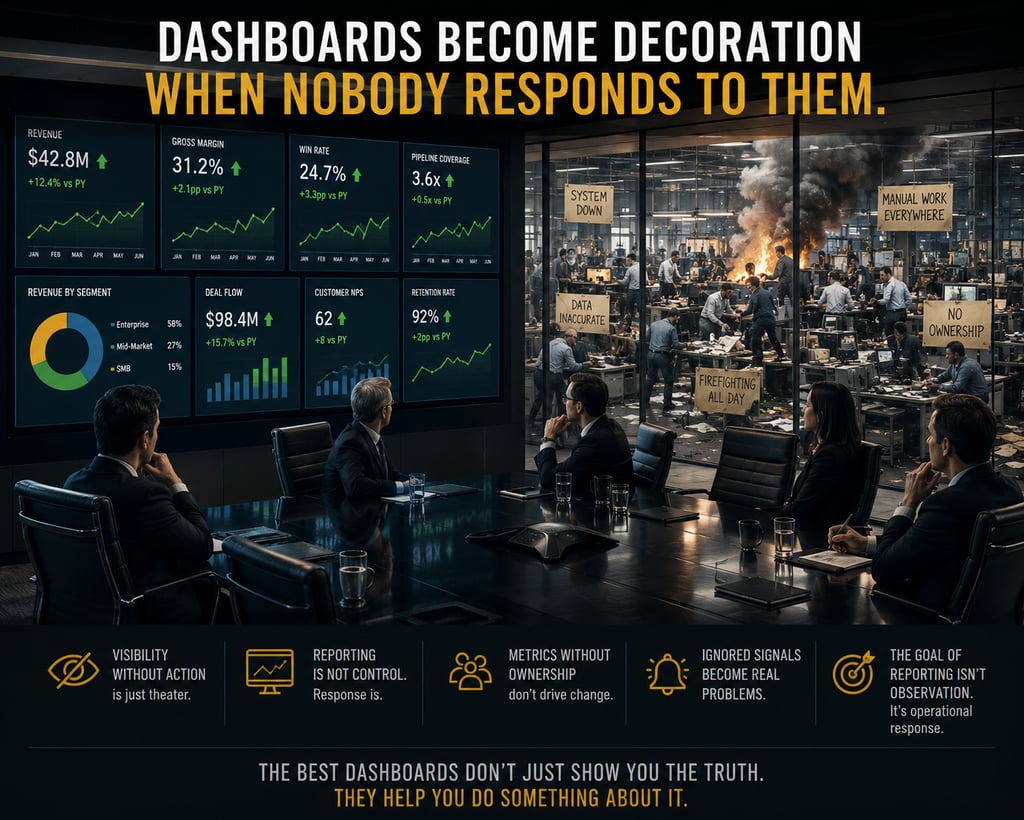
A lot of organizations invest heavily in dashboards, reporting systems, and visibility tools.
And to be fair, visibility matters.
You cannot manage what you cannot see.
But one of the things I’ve observed repeatedly is that dashboards slowly lose operational value when they stop influencing decisions.
At that point, they become decoration.
The organization still reviews the dashboards.
The reports still get generated.
The KPI meetings still happen.
But behavior doesn’t meaningfully change afterward.
That’s an important distinction.
Because the goal of reporting is not observation.
The goal is operational response.
I think many companies unintentionally confuse:
visibility
reporting maturity
dashboard sophistication
…with operational effectiveness.
But reporting maturity and operational maturity are not always the same thing.
Some organizations become incredibly good at surfacing problems while becoming surprisingly ineffective at responding to them.
And over time, employees notice this.
They quickly learn:
which metrics actually matter
which dashboards influence decisions
which KPIs leadership responds to
and which reports exist mostly for appearance
That creates a subtle but important cultural shift.
Metrics stop feeling operationally meaningful and start feeling performative.
The dashboard still exists.
But the organization no longer believes the information meaningfully changes anything.
This is where dashboards become organizational theater.
I’ve seen this happen in companies where:
warning indicators were visible for months
declining performance was measurable
operational friction was obvious
customer dissatisfaction was already surfacing
Yet nothing materially changed because the organization had operationalized reporting without operationalizing response.
That’s the real failure point.
The issue usually isn’t lack of visibility.
It’s lack of ownership, accountability, prioritization, or willingness to act on what the visibility reveals.
And ironically, the more dashboards organizations create, the easier it sometimes becomes to dilute attention.
When everything is measured constantly, very little receives meaningful focus.
The best reporting systems are not the ones with the most metrics.
They are the ones that most clearly connect:
visibility
accountability
decision-making
and operational action
Because dashboards only create value when they help organizations do something differently.
Otherwise they eventually become decoration.
Related Articles by Carter Cathey
About Carter Cathey
Carter Cathey is a sales and revenue leader with more than 20 years of experience helping market research, technology, and private-equity-backed businesses scale revenue, improve operations, and build predictable growth systems.
Throughout his career, he has led sales transformation initiatives, pricing strategy projects, subscription business model transitions, operational redesign efforts, and commercial growth programs.
He writes about leadership, organizational design, business systems, data-driven decision making, and the challenges companies face as they scale.
Learn more about Carter Cathey