
Growth & Scaling: The Difference Between a Startup and a Company
Many organizations mistake growth for scalability. This article explores the fundamental difference between startups and companies, examining why startups succeed through heroics while companies succeed through systems, repeatability, and organizational design. The transition from dependence on individuals to dependence on processes is often what determines whether a business can truly scale.
Carter Cathey
7/8/20263 min read
Most people think the difference between a startup and a company is measured by revenue, funding, or headcount.
I don't think that's the real distinction.
I've worked with organizations ranging from small startups to global enterprises, and the biggest difference isn't size. It's how the business operates.
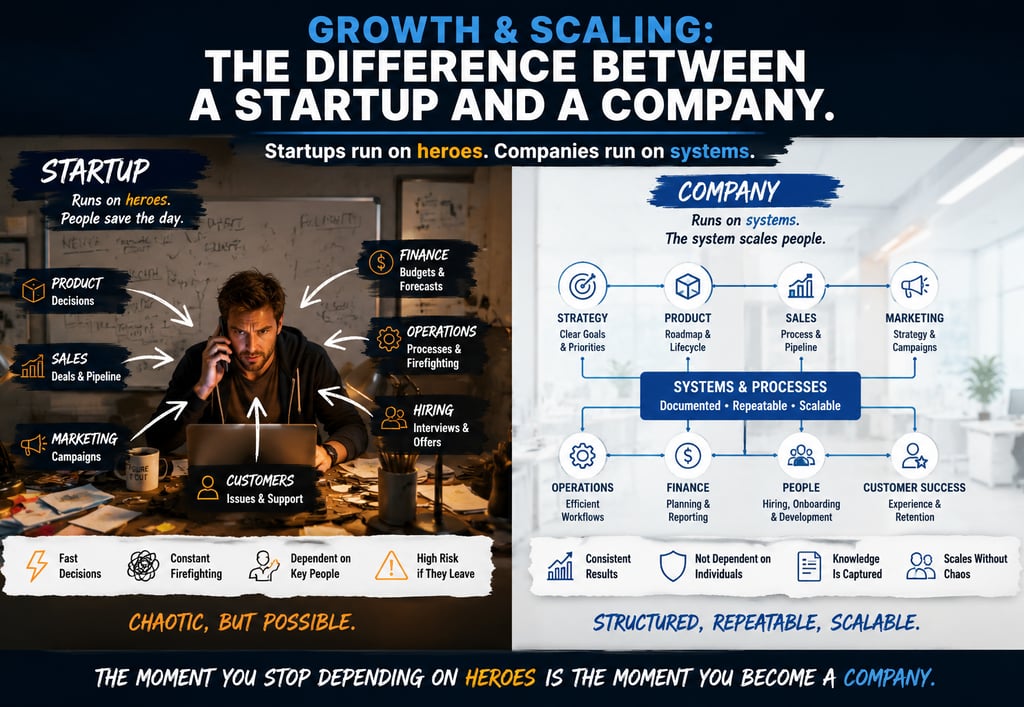
Startups run on heroes.
Companies run on systems.
That isn't a criticism of startups. In fact, heroics are often exactly what a startup needs.
When resources are limited and uncertainty is high, success often depends on a small group of exceptional people who are willing to solve problems, wear multiple hats, and do whatever is necessary to move the business forward.
The founder closes deals.
The salesperson creates proposals.
The engineer handles customer support.
Everyone does a little bit of everything.
And it works.
Until it doesn't.
Success Creates an Illusion
One of the biggest dangers in growth is that early success can create the illusion that the operating model is scalable.
A startup may believe its success is the result of great processes.
In reality, it may be the result of extraordinary people compensating for the lack of processes.
I've written previously about how early success can create bad habits. Many of the shortcuts that help a company survive in its early days eventually become obstacles to scale.
The CRM doesn't need to be perfect.
Documentation can wait.
Processes can be informal.
Communication happens naturally because everyone sits together.
None of those things feel like problems when the company is small.
The problems emerge later.
The Hero Becomes the Bottleneck
One of the clearest signs that a startup is struggling to become a company is when the organization's success depends on a handful of individuals.
The founder approves every major decision.
The top salesperson knows how pricing really works.
One operations leader understands all the exceptions.
A single engineer knows how critical systems function.
At first, these people feel invaluable.
Eventually, they become bottlenecks.
I explored this challenge in How Systems Work: When the Founder Becomes the Bottleneck. The very people who helped create success often become the limiting factor because the business has grown beyond what any individual can manage.
The issue isn't talent.
The issue is dependency.
Communication Stops Scaling
In a startup, communication happens through proximity. Everyone hears the same conversations. Everyone understands the context. Everyone knows what is happening.
As organizations grow, that becomes impossible.
I've written about this in Growth & Scaling: The Moment Communication Stops Scaling.
What feels like alignment in a startup is often just proximity. Once teams become larger, distributed, and specialized, knowledge must move from people into systems. If it doesn't, confusion replaces alignment.
Pricing drifts.
Processes vary.
Different teams begin operating under different assumptions.
Communication hasn't failed. The communication model has.
The Shift from Heroes to Systems
The moment a business begins to scale, it must start asking different questions.
Instead of: "Who can solve this problem?"
The question becomes: "How do we solve this problem every time?"
That is the transition from startup to company.
Systems don't eliminate the need for talented people.
They make success less dependent on any single person.
Processes become repeatable.
Knowledge becomes documented.
Decisions become consistent.
New employees can be productive faster.
The business becomes more resilient.
As I discussed in How Systems Work: Why Repeatability Is the Real Product of Operations, the goal of operations isn't efficiency.
The goal is repeatability. Because repeatability is what creates scale.
Role Clarity Becomes Essential
Another major transition occurs as organizations grow. In a startup, flexibility is an advantage. Everyone contributes wherever needed. In a company, that same flexibility can create inefficiency.
As organizations mature, role clarity becomes increasingly important.
I've seen companies hire highly compensated specialists and then ask them to spend most of their time doing administrative work, creating documents, chasing approvals, and performing tasks that don't require their expertise.
I explored this issue in Growth & Scaling: Why Clarity of Roles Becomes Essential as Companies Grow.
The question isn't whether the work is important. The question is whether the right people are doing it.
Companies scale when people spend most of their time creating value in the areas where they are uniquely qualified.
Final Thought
Startups are built by exceptional people doing extraordinary things.
Companies are built when those extraordinary things become ordinary, repeatable, and scalable.
The goal isn't to eliminate heroes.
The goal is to ensure the business can succeed even when the hero isn't in the room.
Because the moment a business stops depending on heroes and starts depending on systems is often the moment it truly becomes a company.
Related Articles by Carter Cathey
About Carter Cathey
Carter Cathey is a sales and revenue leader with more than 20 years of experience helping market research, technology, and private-equity-backed businesses scale revenue, improve operations, and build predictable growth systems.
Throughout his career, he has led sales transformation initiatives, pricing strategy projects, subscription business model transitions, operational redesign efforts, and commercial growth programs.
He writes about leadership, organizational design, business systems, data-driven decision making, and the challenges companies face as they scale.
Learn more about Carter Cathey