
When a Company Looks Operationally Mature… But Doesn’t Scale
Many mid-stage companies appear operationally mature with defined roles, tools, and growing teams, but lack the underlying systems required to scale. Disconnected tools, unclear processes, and siloed execution create complexity without leverage, slowing growth instead of accelerating it. True operational maturity comes from integrated systems and repeatable workflows—not just added structure.
Carter Cathey
5/18/20261 min read
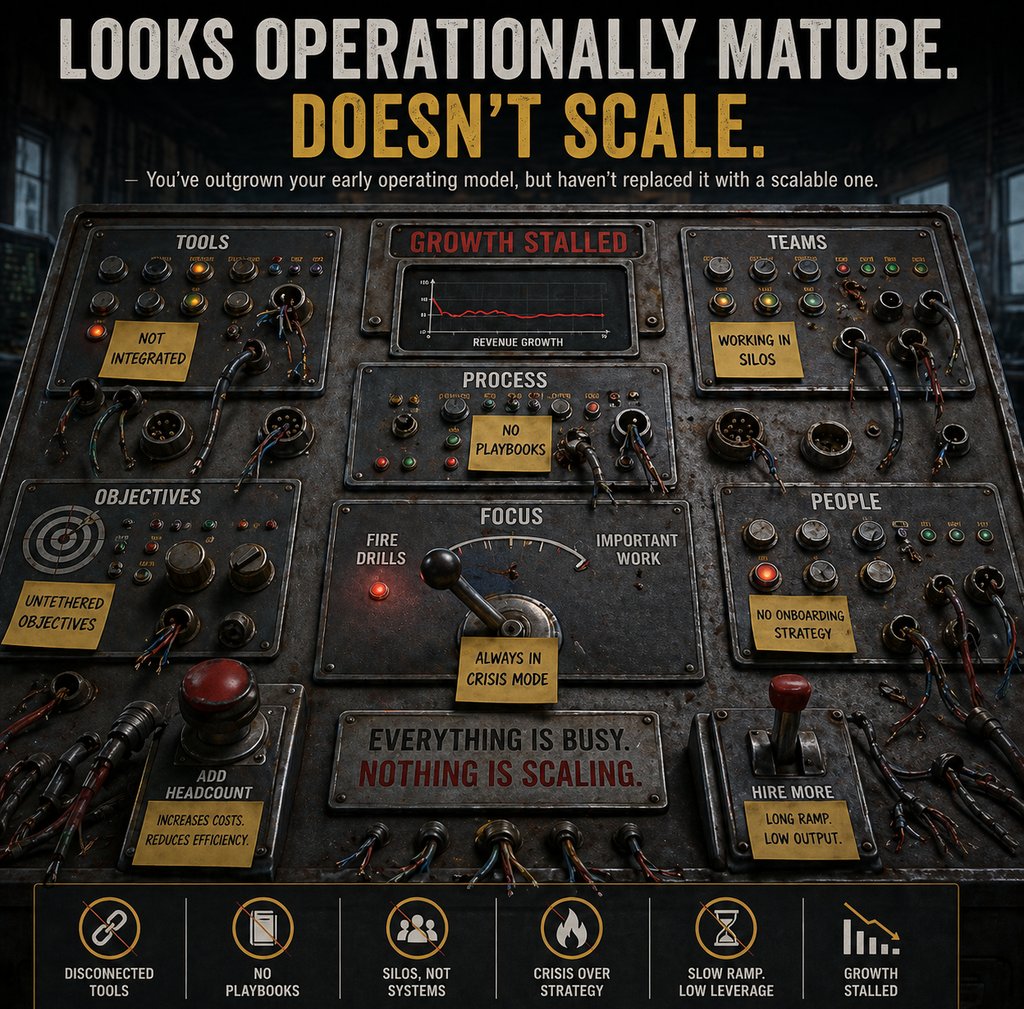
There is a stage where a company looks operationally mature, but stops scaling.
It has the tools.
It has the roles.
It has the headcount.
On the surface, it looks like a company that should be growing.
But when you look closer, the cracks start to show.
The tools aren’t integrated. Data lives in different places and doesn’t flow. Teams are working hard, but not working together. Roles exist, but there is no clear definition of how those roles should operate or interact.
There are no real playbooks. Success lives in the heads of a few experienced people, not in a system that others can follow. New hires don’t step into a process—they spend months trying to figure one out.
At the same time, the organization gets pulled into constant urgency. One issue after another. Teams spend their time reacting to what’s on fire instead of building what will prevent the next fire.
Everyone is busy.
Nothing compounds.
This is the moment where growth starts to stall.
And the instinct is almost always the same.
Hire more people.
Add more tools.
Increase activity.
But if the underlying system isn’t built to scale, more people don’t create leverage.
They create complexity.
Every new hire increases coordination costs. Every new tool adds another layer of fragmentation. Efficiency goes down, not up.
The company didn’t fail to grow because people stopped working.
It stalled because the system never evolved.
Early-stage companies are efficient because they are simple.
Mid-stage companies become inefficient when they add complexity without structure.
Operational maturity isn’t defined by how many tools or roles you have.
It’s defined by how well they work together.
You don’t fix this stage by hiring more people.
You fix it by building the system those people should be operating in.
Related Articles by Carter Cathey
About Carter Cathey
Carter Cathey is a sales and revenue leader with more than 20 years of experience helping market research, technology, and private-equity-backed businesses scale revenue, improve operations, and build predictable growth systems.
Throughout his career, he has led sales transformation initiatives, pricing strategy projects, subscription business model transitions, operational redesign efforts, and commercial growth programs.
He writes about leadership, organizational design, business systems, data-driven decision making, and the challenges companies face as they scale.
Learn more about Carter Cathey