
The Moment Instinct Stops Scaling
Many successful companies are initially built through founder instinct, rapid decision-making, and close operational proximity. However, as organizations grow in complexity, intuition alone becomes increasingly difficult to scale across teams, systems, and markets. Sustainable growth requires leaders to augment instinct with instrumentation—metrics, visibility, feedback loops, and operational systems that surface reality faster than intuition alone can.
Carter Cathey
6/3/20261 min read
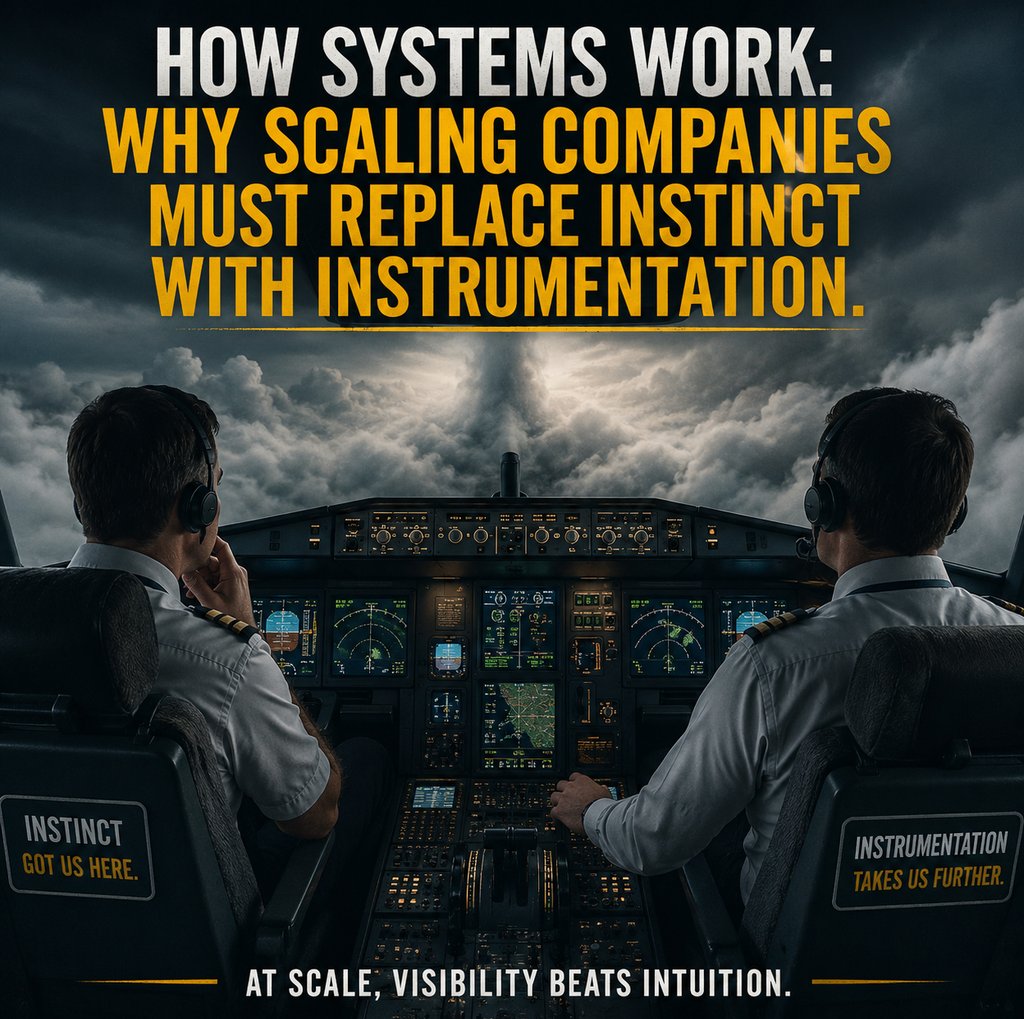
One of the hardest transitions for founders and leaders is recognizing when instinct stops being enough.
In the early stages of a company, instinct is incredibly powerful.
The organization is small. Communication is direct. The founder is close to the customers, the product, the sales process, and the operational problems. Decisions happen quickly because the people making them are close to the work.
In many cases, the company succeeds precisely because the founder trusted instinct when others hesitated.
That works remarkably well for a long time.
Until complexity starts to outgrow proximity.
The company gets bigger:
more employees
more customers
more products
more systems
more dependencies
more decisions
At that point, leaders are no longer personally close to every signal inside the organization.
And this is where instinct alone starts to fail.
Not necessarily because the instinct is bad.
Sometimes the instinct is still correct.
The problem is that instinct doesn’t scale well.
It surfaces too slowly.
It depends too heavily on proximity.
It cannot easily transfer across teams and layers of leadership.
As organizations grow, leaders eventually face a difficult transition.
They have to move from being creators to becoming operators.
That’s a major mindset shift.
Creators rely heavily on:
intuition
speed
improvisation
direct involvement
Operators build:
visibility
instrumentation
repeatability
scalable systems
At small scale, leaders can feel problems.
At larger scale, they need systems that reveal problems before instinct catches up.
This is where instrumentation becomes critical.
Instrumentation means creating mechanisms that continuously surface operational reality:
metrics
dashboards
process visibility
feedback loops
leading indicators
operational monitoring
Not because instinct no longer matters.
But because organizations eventually become too complex to run on feel alone.
The goal isn’t to eliminate human judgment.
It’s to stop depending on instinct as the primary operating system of the company.
Great founders build companies through instinct.
Great operators build systems that allow organizations to scale beyond it.
Related Articles by Carter Cathey
About Carter Cathey
Carter Cathey is a sales and revenue leader with more than 20 years of experience helping market research, technology, and private-equity-backed businesses scale revenue, improve operations, and build predictable growth systems.
Throughout his career, he has led sales transformation initiatives, pricing strategy projects, subscription business model transitions, operational redesign efforts, and commercial growth programs.
He writes about leadership, organizational design, business systems, data-driven decision making, and the challenges companies face as they scale.
Learn more about Carter Cathey