Growth & Scaling: When Organizational Design Becomes a Competitive Advantage
Many companies view process and systems as bureaucracy. The reality is that well-designed workflows create efficiency, improve customer experience, reduce errors, and enable scale. When organizational design is treated as a strategic capability rather than administrative overhead, it becomes a powerful competitive advantage.
Carter Cathey
7/17/20264 min read
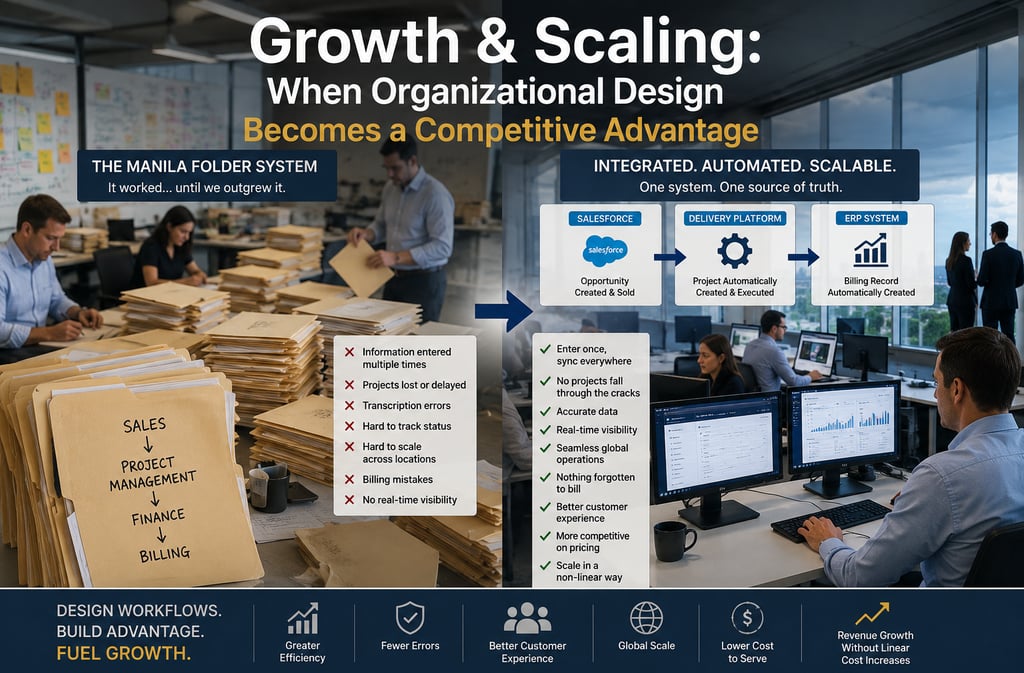
Early in my career at e-Rewards Market Research, we operated on what we called the "Manila Folder System." Every project sold generated a physical folder.
The salesperson would complete their portion, assemble the materials, and physically hand the folder to the project management team. Once the project was completed, the folder would move to Finance for billing.
It was simple. It was tangible. It was low tech. And surprisingly, it worked remarkably well.
For a long time.
The organization grew quickly using this process. Thousands of projects were sold, executed, and billed using nothing more than people, procedures, and a steady supply of manila folders.
Many founders would look at that and conclude that formal systems weren't necessary. The reality was exactly the opposite. The success of the process eventually exposed its limitations.
Every System Has a Scaling Limit
The Manila Folder System worked because everyone was largely located in the same place. A salesperson could walk a folder to a project manager. A manager could stop by someone's desk to check status. Finance could easily locate paperwork.
The workflow was visible. The process was understandable. But growth changes the requirements of a business.
When we opened offices in New York and Los Angeles, we quickly discovered that physical workflows do not scale geographically. Folders don't travel particularly well across the country. At the same time, project volume continued increasing.
More projects meant more handoffs.
More handoffs meant more opportunities for failure.
Projects occasionally became difficult to locate.
Information sometimes needed to be re-entered.
Mistakes occurred.
Nothing was catastrophic, but the warning signs were becoming obvious. The organization was approaching the limits of the system that had gotten us there.
The Hidden Cost of Fragmented Systems
Like many growing companies, we already had technology.
Sales worked inside Salesforce.
Project delivery utilized a proprietary internal platform.
Finance operated through an ERP system.
The problem wasn't a lack of technology. The problem was that none of the technology spoke to each other. Every project required information to be entered multiple times.
Sales entered it once.
Operations entered it again.
Finance entered it again.
Every duplicate entry created risk.
Transcription errors.
Missing information.
Incorrect project details.
Billing mistakes.
Lost time.
The company was spending resources managing the gaps between systems.
Integration Wasn't an IT Project
Many organizations view system integration as a technical initiative. In reality, it is an organizational design initiative. The question wasn't: "How do we connect these systems?" The question was: "How should work flow through the company?"
Those are very different conversations. We began designing the organization around the ideal customer journey rather than around departmental boundaries.
What should happen the moment a deal closes?
What information should move automatically?
Who should be notified?
What should never require manual intervention?
What data should exist only once?
Answering those questions led to a fully integrated workflow.
The Competitive Advantage Nobody Could See
Once integrated, the impact was immediate.
Sales entered project information once.
The delivery platform automatically received the information.
The ERP automatically created the billing record.
All three systems remained synchronized. The benefits were significant.
Projects no longer fell through the cracks.
Transcription errors virtually disappeared.
Billing became more accurate.
Workflows became faster.
Internal visibility improved.
Global teams could collaborate seamlessly.
Customers experienced faster execution and fewer mistakes.
Most importantly, scale became possible. The organization could handle substantially more volume without adding people at the same rate.
Scale Is About More Than Growth
Many leaders use the words growth and scale interchangeably, but they are not the same thing. Growth simply means revenue increases. Scale means revenue increases faster than costs.
A company that doubles revenue while doubling headcount has grown. A company that doubles revenue while increasing headcount by twenty percent has scaled. The difference is almost always found in systems, workflows, automation, and organizational design.
Those investments create leverage.
Leverage allows each employee to contribute more output.
Leverage allows the organization to serve more customers.
Leverage allows profitability to improve as the company grows.
Process Is Not Bureaucracy
Founders often resist process because they associate it with bureaucracy. It is not unusual for the words "process" and "red tape" to be used interchangeably.
Bad process certainly exists. But good process removes friction.
Good process eliminates unnecessary work.
Good process reduces mistakes.
Good process improves customer experiences.
Good process allows talented people to focus on high-value activities instead of administrative tasks.
The best operational systems are often invisible. Customers never see them. You will never present it at an industry trade show to "wow" new customers. Employees stop thinking about them.
Work simply flows.
Designing for the Company You Intend to Become
One of the most important leadership responsibilities is designing infrastructure for future growth rather than current needs. The Manila Folder System was perfect for the company we were. The integrated workflow platform was necessary for the company we wanted to become. That distinction matters.
Organizations that wait until systems break before investing often find themselves trapped by growth. Organizations that design for the future create capacity before they need it. That capacity becomes a competitive advantage.
Eventually competitors can copy products.
They can copy pricing.
They can copy messaging.
What is much harder to copy is a well-designed organization that consistently sells, delivers, invoices, and supports customers better than everyone else.
That is when organizational design stops being administrative work and becomes strategic advantage.
Recommended Internal Links
This article connects naturally to:
About Carter Cathey
Carter Cathey is a sales and revenue leader with more than 20 years of experience helping market research, technology, and private-equity-backed businesses scale revenue, improve operations, and build predictable growth systems.
Throughout his career, he has led sales transformation initiatives, pricing strategy projects, subscription business model transitions, operational redesign efforts, and commercial growth programs.
He writes about leadership, organizational design, business systems, data-driven decision making, and the challenges companies face as they scale.
Learn more about Carter Cathey