Growth & Scaling: Why Clarity of Roles Becomes Essential as Companies Grow
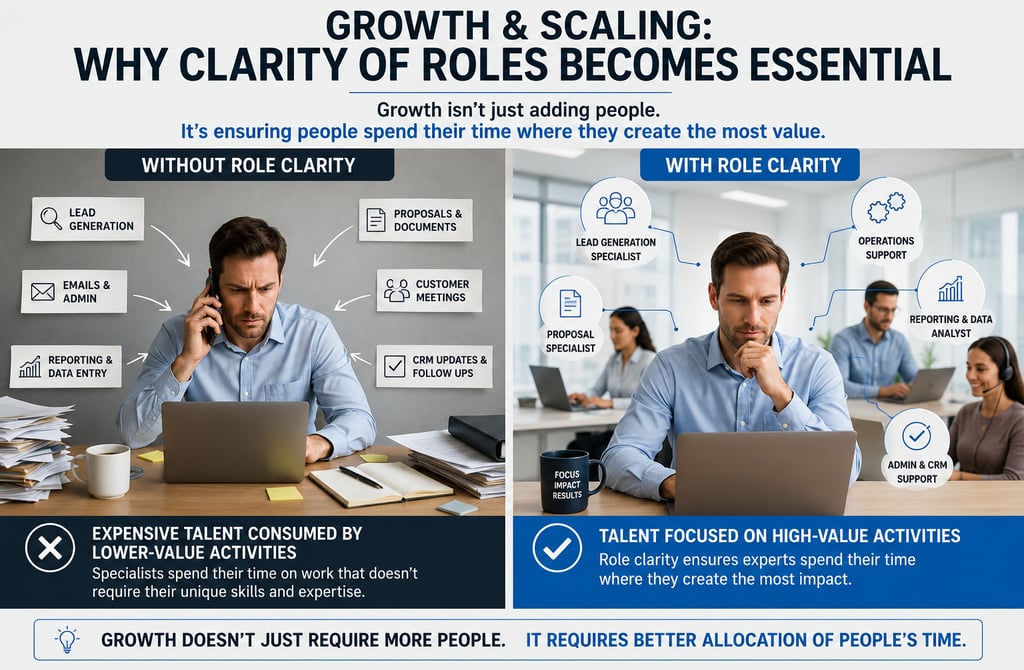
As organizations grow, role ambiguity becomes increasingly expensive. While flexibility is often a strength in small companies, scaling requires greater clarity around responsibilities, ownership, and how people spend their time. The most effective organizations ensure talented employees focus on the work where they create the greatest value rather than becoming consumed by lower-value activities.
Carter Cathey
7/6/20263 min read
One of the most interesting exercises I've done throughout my career is comparing two things:
What a person's job description says they do.
And
How they actually spend their time.
The results are almost always revealing.
In most organizations, there is usually reasonable alignment around the expected outcome of a role. Salespeople are expected to generate revenue. Managers are expected to lead teams. Analysts are expected to produce insights.
Where things become much less clear is the "how."
What work are people actually doing every day?
How much of their time is spent on activities that require their expertise?
How much is spent on tasks that simply need to get done?
As organizations grow, these questions become increasingly important.
Small Companies Thrive on Flexibility
In small companies, role clarity is often unnecessary. Everyone does a little bit of everything. The salesperson sells, creates proposals, updates the CRM, tracks projects, and handles customer support.
The founder hires employees, manages finances, approves invoices, closes deals, and troubleshoots operational issues. Nobody worries much about organizational charts. The priority is survival and growth.
In many cases, this flexibility is a competitive advantage. Problems get solved quickly. Decisions get made. Customers get served. Revenue gets generated.
But what works at ten employees rarely works at two hundred.
The Hidden Cost of Ambiguity
As companies grow, role ambiguity becomes increasingly expensive. Work starts getting duplicated. Important responsibilities fall through the cracks. Decisions become slower because ownership is unclear. Accountability becomes difficult because nobody knows exactly who is responsible.
But perhaps the biggest cost is something many organizations never measure.
Highly compensated specialists begin spending large portions of their time doing work that doesn't require their expertise.
The Sales Example
I've seen this play out repeatedly in sales organizations.
A company hires experienced sellers because they bring:
industry expertise
relationship-building skills
commercial judgment
negotiation ability
strategic thinking
These individuals are often among the highest-paid employees in the organization.
Then the company asks them to spend their days:
prospecting
researching leads
creating proposals
updating CRM records
chasing internal approvals
handling administrative tasks
supporting post-sale execution/delivery
All of these activities are important. But most of them don't require the unique skills the company is paying a premium for.
Organizations often pay people for their expertise and then consume their time with tasks that don't require it.
The Time-Motion Test
One of the fastest ways to identify inefficiency is to conduct a simple time-motion analysis.
Ask:
How does this person actually spend their time?
Then compare that answer to:
What activities create the most value?
The gaps are often surprising. Many organizations discover they have expensive talent spending large portions of their day performing work that could be handled by lower-cost support functions, automation, or more specialized resources.
The issue isn't that the work isn't important. The issue is that it may not be the highest and best use of that person's time.
Growth Requires Leverage
As companies scale, role clarity is not about creating bureaucracy. It's about creating leverage. The goal is not to make people less flexible. The goal is to ensure that talented people spend most of their time doing the work they are uniquely qualified to perform.
This often means introducing:
sales support functions
operations teams
proposal specialists
coordinators
analysts
process owners
Many leaders initially view these roles as overhead. What they often discover is that these functions create capacity. When lower-value activities are shifted away from highly compensated specialists, productivity increases dramatically.
The organization may add headcount while simultaneously becoming more efficient.
Final Thought
Early-stage companies succeed because everyone does everything.
Scaled companies succeed because everyone understands what they should be doing.
Growth eventually forces organizations to answer an important question: Are people spending their time where they create the most value?
Because growth doesn't just require more people. It requires better allocation of people's time. And role clarity is often the mechanism that makes scale possible.
Related Articles by Carter Cathey
About Carter Cathey
Carter Cathey is a sales and revenue leader with more than 20 years of experience helping market research, technology, and private-equity-backed businesses scale revenue, improve operations, and build predictable growth systems.
Throughout his career, he has led sales transformation initiatives, pricing strategy projects, subscription business model transitions, operational redesign efforts, and commercial growth programs.
He writes about leadership, organizational design, business systems, data-driven decision making, and the challenges companies face as they scale.
Learn more about Carter Cathey