
Data, Reporting, and Visibility: Why Leaders Often Ask Questions Systems Can't Answer
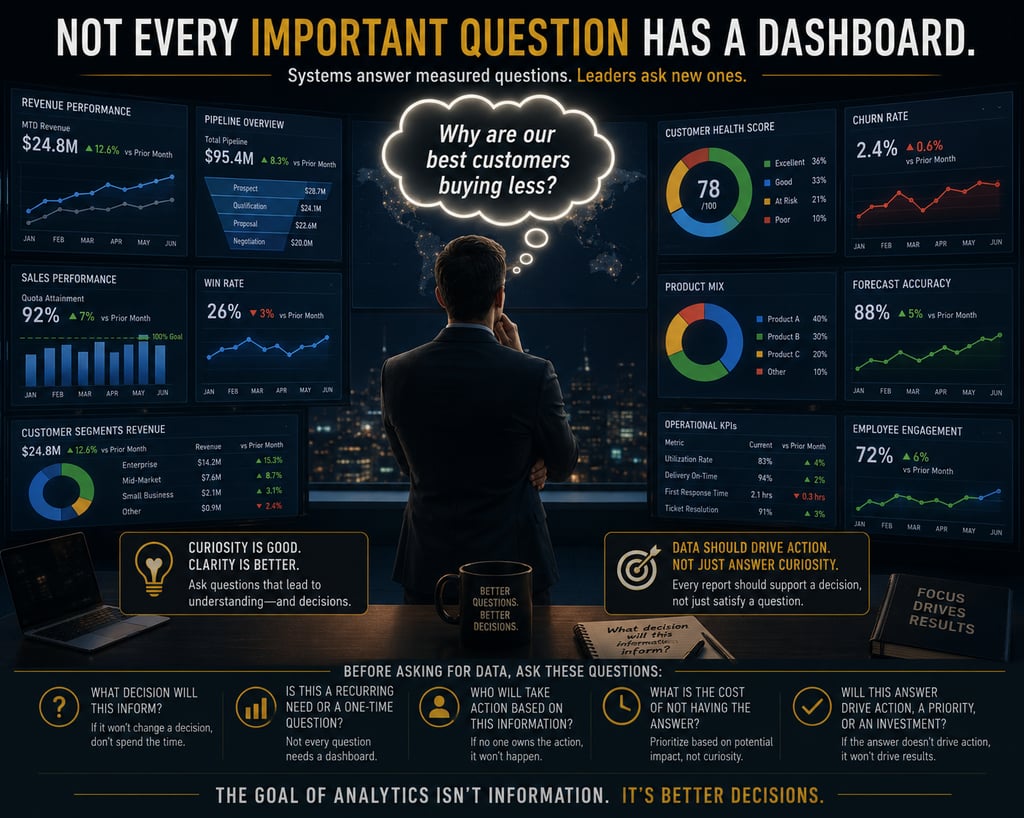
Good leaders constantly ask questions in pursuit of deeper understanding, and many of those questions fall outside existing reporting systems. The challenge is not that systems fail to answer every question, but that organizations must distinguish between curiosity-driven analysis and decision-driven analysis. Data becomes most valuable when it informs action rather than simply generating more questions.
Carter Cathey
6/26/20262 min read
One of the most common frustrations I encountered while supporting executive teams was hearing some version of: "Why can't our systems answer this question?"
My response was often: "Because nobody ever thought to measure it."
And honestly, that's not necessarily a problem.
One of the things I've learned over the years is that good leaders frequently ask questions systems can't answer. That's often a sign of curiosity, not failure.
Strong leaders are constantly trying to better understand:
customers
employees
markets
competitors
operational performance
Not every important question starts as a dashboard.
In fact, many important questions begin as observations, instincts, or concerns that eventually reveal gaps in existing measurement systems.
I also think organizations often confuse ad hoc analysis with permanent reporting requirements.
Not every question deserves:
a dashboard
a KPI
a recurring report
a monthly review meeting
Sometimes a question only needs to be answered once. A few hours of analysis may be all that's required.
The bigger challenge I encountered was something else entirely. Whenever executives asked for data, I started asking a simple question: "What decision will you make based on this information?"
The answers were often revealing. Sometimes there was a very clear decision attached to the request. But many times, the request was driven primarily by curiosity. And while curiosity is valuable, I noticed something interesting.
The curiosity-driven requests almost always followed the same pattern:
We answer the question.
That answer creates three new questions.
Those answers create five more questions.
And eventually the organization becomes trapped in a cycle of gathering information without ever making a decision.
At that point, analytics stops supporting decision-making and starts delaying it.
I'm not against curiosity. Far from it. Some of the best operational insights I've ever uncovered started with a leader asking a question nobody had considered before.
But I do think organizations need to distinguish between:
information gathering
decision support
Because those are not the same thing.
The purpose of business analytics is not simply to answer questions. It's to improve decisions. Not every important question has a dashboard. But every data request should have a clear connection to understanding, action, or decision-making.
Otherwise, data gathering can quietly become a substitute for leadership.
Related Articles by Carter Cathey
About Carter Cathey
Carter Cathey is a sales and revenue leader with more than 20 years of experience helping market research, technology, and private-equity-backed businesses scale revenue, improve operations, and build predictable growth systems.
Throughout his career, he has led sales transformation initiatives, pricing strategy projects, subscription business model transitions, operational redesign efforts, and commercial growth programs.
He writes about leadership, organizational design, business systems, data-driven decision making, and the challenges companies face as they scale.
Learn more about Carter Cathey