
Growth & Scaling: Why Every Scaling Company Eventually Needs Structure
Growth eventually creates more complexity than informal systems can manage. This article explores why every scaling company ultimately needs structure—not as a form of bureaucracy, but as a mechanism for communication, decision-making, accountability, and repeatability. The organizations that scale most successfully are often the ones that intentionally design their structures before growth forces the issue.
Carter Cathey
7/10/20263 min read
One of the most common objections I hear when discussing organizational growth is some variation of:
"We don't want to become bureaucratic."
I understand the concern.
Nobody starts a company dreaming about policies, processes, reporting structures, governance committees, or approval workflows. Most successful businesses begin with exactly the opposite mindset.
Move fast
Stay flexible
Solve problems
Figure it out
And for a while, that works exceptionally well. In fact, flexibility is often one of the greatest advantages a young company has over larger competitors. The problem is that growth eventually creates complexity.
And complexity eventually requires structure.
The Misunderstood Nature of Structure
Many leaders hear the word "structure" and immediately think:
bureaucracy
red tape
unnecessary meetings
slower decisions
loss of agility
But structure is not the opposite of growth. In many cases, structure is what allows growth to continue.
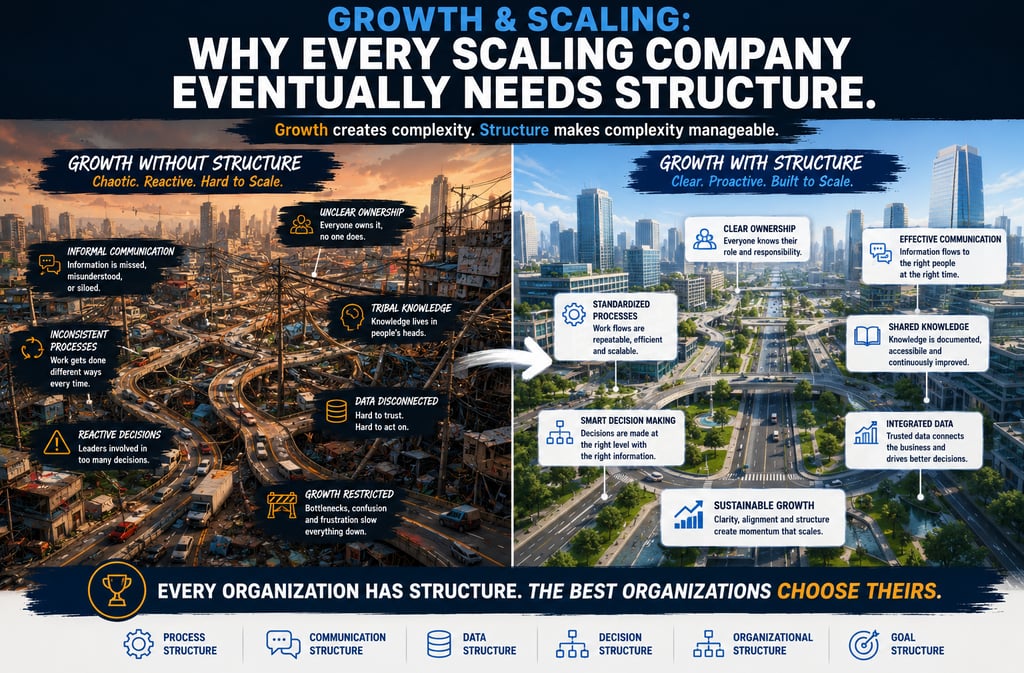
The reality is that every organization has structure.
The only question is whether it was intentionally designed or whether it emerged accidentally over time.
Small Companies Often Mistake Proximity for Structure
One of the reasons structure feels unnecessary in the early stages is because the company already has a structure.
It just isn't formal.
The structure is:
proximity
relationships
tribal knowledge
direct communication
founder involvement
When everyone sits together, everyone hears the same conversations. When a question arises, people simply ask. When priorities shift, the founder tells everyone directly. Alignment happens naturally.
Or at least it appears to.
I've written previously about The Moment Communication Stops Scaling. One of the biggest surprises many leaders encounter is discovering that what they believed was organizational alignment was often just physical proximity.
As companies grow, that advantage disappears.
Growth Creates Complexity
At ten employees, informal systems work remarkably well. At one hundred employees, those same systems often begin to fail.
New departments emerge
Additional layers of management appear
Products become more complex
Customers become more demanding
Geography expands
Communication becomes harder
Decision-making slows
The organization starts experiencing growing pains. Many leaders interpret this as something breaking.
In reality, the business may simply be outgrowing its informal operating model.
Structure Takes Many Forms
One of the mistakes companies make is assuming structure means organizational charts.
Organizational structure is only one piece.
Growing companies eventually need:
1) Process Structure
How does work move through the organization?
Who owns each step?
What happens next?
2) Communication Structure
How are priorities communicated?
How do teams remain aligned?
How does information flow?
3) Data Structure
What gets measured?
How is it defined?
Who owns it?
Can people trust it?
4) Decision Structure
Who can make which decisions?
Which decisions require approval?
Which decisions are delegated?
5) Organizational Structure
Who owns what?
Who reports to whom?
How is accountability established?
All of these structures exist in every organization.
The question is whether they are intentional.
The Founder Challenge
One of the clearest examples of structure becoming necessary is founder dependency. In the early stages, founder involvement creates speed.
The founder knows everything.
The founder makes decisions quickly.
The founder solves problems.
But as I discussed in When the Founder Becomes the Bottleneck, growth eventually pushes organizations beyond the bandwidth of any one individual. What once accelerated growth begins limiting it.
The answer isn't replacing the founder. The answer is building structures that allow decisions, information, and accountability to scale beyond the founder.
The Role Clarity Challenge
Structure also becomes essential as organizations become more specialized.
In Why Clarity of Roles Becomes Essential as Companies Grow, I discussed how many organizations hire highly skilled employees and then consume their time with activities that don't require their expertise.
As businesses scale, role clarity becomes increasingly important. Not because specialization is fashionable. Because leverage becomes necessary.
Growth eventually requires people to spend more of their time doing the work that creates the greatest value.
Structure makes that possible.
The Repeatability Challenge
Perhaps the most important form of structure is repeatability.
Many businesses achieve success because extraordinary people overcome problems.
But organizations cannot scale indefinitely on heroics.
As I explored in Why Repeatability Is the Real Product of Operations, the ultimate goal of many operational systems is not efficiency.
It's repeatability.
Can the organization consistently produce the same result regardless of who happens to be working that day?
Can success be taught?
Can it be documented?
Can it be repeated?
If not, scale becomes difficult.
Structure Is Not Bureaucracy
The best organizations understand an important distinction. Structure and bureaucracy are not the same thing. Bureaucracy exists to control people. Structure exists to enable people.
Good structure reduces confusion.
Good structure accelerates decision-making.
Good structure improves communication.
Good structure creates consistency.
Good structure allows organizations to scale.
The goal is not to add process. The goal is to remove friction.
Final Thought
Startups grow because talented people figure things out. Scaling companies grow because structure allows talented people to work together consistently. Every company eventually reaches a point where growth creates more complexity than informal systems can manage.
When that moment arrives, leaders face a choice. Continue relying on heroics. Or build the structures that allow success to scale.
The organizations that navigate this transition successfully often discover something surprising: Structure isn't what slows growth.
Structure is what makes the next stage of growth possible.
Related Articles by Carter Cathey
About Carter Cathey
Carter Cathey is a sales and revenue leader with more than 20 years of experience helping market research, technology, and private-equity-backed businesses scale revenue, improve operations, and build predictable growth systems.
Throughout his career, he has led sales transformation initiatives, pricing strategy projects, subscription business model transitions, operational redesign efforts, and commercial growth programs.
He writes about leadership, organizational design, business systems, data-driven decision making, and the challenges companies face as they scale.
Learn more about Carter Cathey